

Pull a modern basketball rookie out of a pack, and you're holding the great-great-grandchild of a cigarette card. The most expensive baseball cards ever sold aren't just trophies for one sport — they're the origin story of the entire trading card hobby. Before there were football rookies, before Panini and Upper Deck, before the word "grading" meant anything, there was a Honus Wagner card pulled from production in 1909 and a Mickey Mantle that a dealer once sold for $50,000, calling it the "finest in the world."
Football, basketball, and hockey cards all borrowed the template from baseball cards. The tobacco-era inserts of the 1880s, the gum cards of the 1930s, the 1952 Topps set that invented the modern format we still use today — every one of those milestones happened in baseball first. So this isn't just a list of expensive cardboard. It's a walk through the foundation the whole hobby stands on, ranked by verified auction record, with named provenance for every entry.
If you've inherited a shoebox of old cards or you're staring at a collection you've never cataloged, the first move isn't selling — it's knowing what you have. Capture every card, every grade, every set in an organized inventory, then let the market data tell you what's worth grading, what's worth holding, and what's worth letting go. —Collectibles.com
How Baseball Cards Built the Entire Hobby
The claim that sports cards wouldn't exist without baseball cards isn't marketing hyperbole — it's a documented chain of custody across multiple eras.
Image: 1920s baseball cards - Credit: courtesy of PennLive News
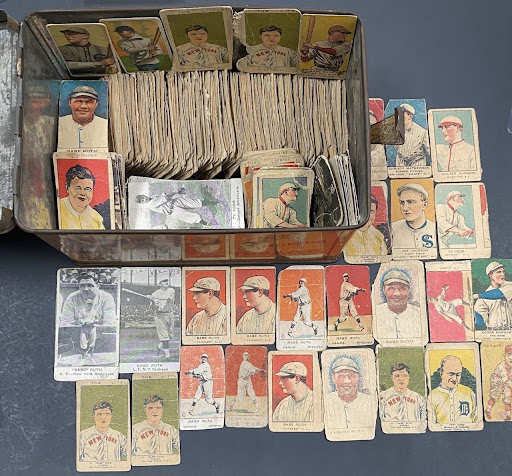
The tobacco era (1860s–1910s): The first baseball cards were advertising. A New York sporting-goods store, Peck & Snyder, printed team trade cards as early as 1868 to sell equipment. Tobacco companies industrialized the idea: Goodwin & Co. issued the massive Old Judge set in the late 1880s, and Allen & Ginter released its first cigarette cards around 1886, stiff cardboard that both protected the cigarettes and turned buyers into collectors. These firms merged into the American Tobacco Company, which issued the legendary T206 set (1909–1911) — the set that gave us the Wagner.
The gum-and-candy era (1910s–1930s): As WWI squeezed tobacco cards, candy makers took over. Cracker Jack inserted cards in 1914 and 1915. Then the Goudey Gum Company of Boston released its 1933 "Big League Chewing Gum" set — the first cards packaged with gum, featuring Ruth, Gehrig, and Foxx. (Alongside T206 and 1952 Topps, the 1933 Goudey is one of the hobby's classic "Big Three" sets.)
The modern template (1952): Topps' 1952 set — 407 cards designed largely by Sy Berger at his Brooklyn kitchen table — introduced larger cards, real color imagery, team logos, and full statistics on the back. That format became the modern trading card. When football, basketball, and hockey card sets arrived, they copied what baseball had already perfected. That's the factual basis for the whole thesis: the diamond came first, and everything else followed.
The Topps monopoly (1956–1980): In 1956, Topps bought out its last real rival, Bowman, and locked up exclusive contracts with virtually every active MLB player for cards sold with gum. That gave Topps a near-total grip on the baseball card market for the next quarter-century — the era that produced the iconic 1950s and '60s sets collectors chase today. Topps then carried its template into other sports, selling its first NFL football set in 1956 and issuing NBA basketball cards from 1957 onward. The blueprint baseball established was now the industry's default across every sport.
Competition and the junk wax era (1981–early 1990s): The monopoly cracked in 1981, when a Fleer antitrust lawsuit opened the market to competitors. Fleer and Donruss began printing full MLB sets alongside Topps, and to sidestep Topps' surviving exclusive on gum, they packaged their cards with substitutes — Fleer with team logo stickers, Donruss with cardboard puzzle pieces. Three brands quickly became more, and manufacturers responded to booming demand by printing cards in staggering quantities. The result was the "junk wax era" (roughly 1986–1993): so many cards were produced that most from the period remain nearly worthless today, a permanent lesson in how overproduction destroys scarcity.
The premium revolution (1989): Everything changed in 1989, when startup Upper Deck launched with a genuinely new kind of product: thicker glossy cardstock, full-bleed photography, tamper-resistant foil packs, and an anti-counterfeiting hologram on the back — the first in the industry. The set's card #1 was a 19-year-old Seattle Mariners prospect named Ken Griffey Jr., and Upper Deck's decision to anchor its debut on a rookie rather than a veteran essentially invented the modern "chase card." Competitors were forced to launch premium lines of their own (Fleer Ultra, Topps Stadium Club), and the hobby's center of gravity shifted from kids' toys toward serious collectibles. The Griffey rookie is often called the "'52 Mantle of the modern era" — iconic and beloved, though, like most junk wax, printed in the millions rather than truly scarce.
8The modern hobby takes shape (2000s):* The template baseball built kept evolving into the collecting landscape we know now. Insert cards, numbered parallels, pack-pulled autographs, and embedded memorabilia "relic" cards — innovations Upper Deck pioneered in the early '90s — became the industry standard, engineering deliberate scarcity into modern products. Bowman Chrome, revived and refined in the 2000s, turned prospecting into a hobby of its own, with collectors chasing the first cards of players years before they reached the majors. Two forces cemented the modern market: eBay and online marketplaces created a global, always-open trading floor, and third-party grading (PSA founded in 1991, alongside SGC and BGS) gave that market a standardized condition language. A graded, slabbed card was now a comparable financial asset — which is precisely what set the stage for the seven-figure vintage sales, and the pandemic-era boom of 2020–2021, that followed.
8Image: Early 2000s baseball cards - credit: Reddit*
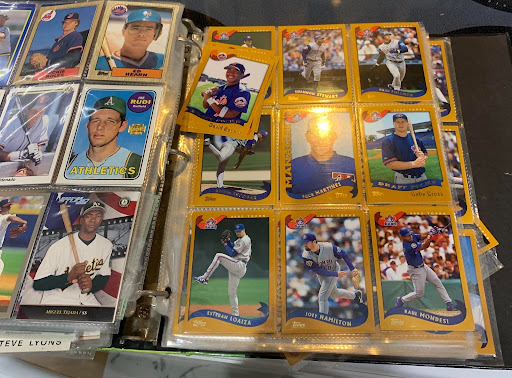
The 5 Most Expensive Vintage Baseball Cards Ever Sold
Ranked strictly by verified sale price, highest first. Because record prices cluster on a handful of trophy names, this list includes two Honus Wagners and two Mickey Mantles — that concentration is itself one of the most important lessons in vintage collecting.
Why These Sold For 7-Figures:
Before the countdown, the framework. Vintage baseball cards hit six and seven figures for the same three reasons any elite collectible does — what serious collectors call the Big Three: Condition, Rarity, and Provenance.
Condition is multiplied by grading: PSA and SGC turned subjective "mint" claims into a standardized language. An ungraded '52 Mantle is a story; a PSA 9 or SGC 9.5 is a comparable, tradeable asset. High-grade survivors of fragile pre-war cardboard are vanishingly rare.
Rarity is often manufactured by accident: The T206 Wagner was pulled from production almost immediately. Print runs, recalls, and short-printed series create scarcity that no reprint can undo.
Provenance is the price multiplier: Every record-setter below traces to a named source — a paperboy, a "Mr. Mint" hoard, a family that held a card for a century. Documented history is what converts a rare card into a legendary one.
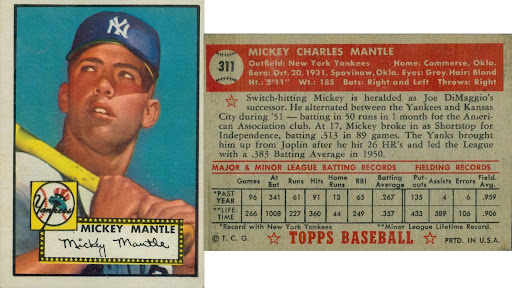
5. 1952 Topps Mickey Mantle #311 (PSA 9) — $5.2 Million
Where: PWCC Marketplace (private sale) ·
When: January 2021
For a brief window in early 2021, this was the most expensive sports card in the world. A PSA 9 (Mint) example of the card that defines postwar collecting — one of only six graded at that level. The 1952 Topps Mantle is the true north of the hobby: not Mantle's rookie card (that's his 1951 Bowman), but the card that became an icon in its own right thanks to the set's landmark design.
The provenance runs through recognizable hands. Former NFL offensive lineman Evan Mathis sold it for $2.88 million at Heritage in April 2018. An intermediate owner then flipped it privately to entrepreneur and actor Rob Gough, who called it "the Mona Lisa of sports cards." PWCC's Jesse Craig described it as the nicest-looking PSA 9 of the card in existence.
What Collectors Should Know: A persistent myth holds that the '52 Mantle is ultra-rare because unsold high-number cards were dumped in the ocean, but Mantle was actually double-printed in Series 6 — the card is iconic and condition-sensitive rather than genuinely scarce.
Image: 1952 Topps Mickey Mantle #311 — credit: MLB
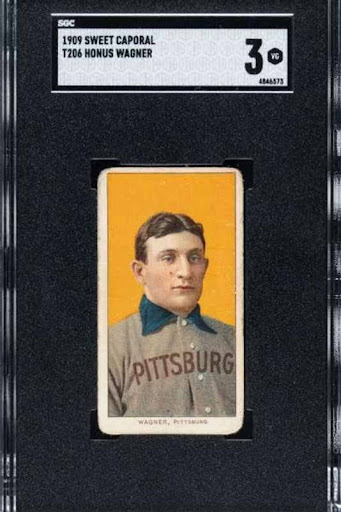
4. 1909–11 T206 Honus Wagner (SGC 3) — $6.61 Million
Where: Robert Edward Auctions ·
**When:**8 August 2021
This SGC 3 (Very Good) Wagner held the all-time sports card record for roughly a year. The final price of $6,606,296 came from a hammer of $5,505,247 plus a 20% buyer's premium — a useful reminder that the number in the headline includes the house's cut.
Its provenance is a snapshot of the hobby's growth. Per Robert Edward Auctions, this copy first sold publicly in the early 1970s for about $1,100 — one of the first significant public baseball card sales anywhere. It was graded SGC 3 in 2012, sold that year for $1.23 million, traded privately for more, then reached $6.6 million in 2021. One card, tracing the entire modern arc of the market.
What Collectors Should Know: The buyer's premium matters when you compare records — a card that "hammers" at $5.5 million and one that "sells" at $6.6 million can be the same transaction described two different ways.
Image: T206 Honus Wagner (SGC 3) — credit: ESPN
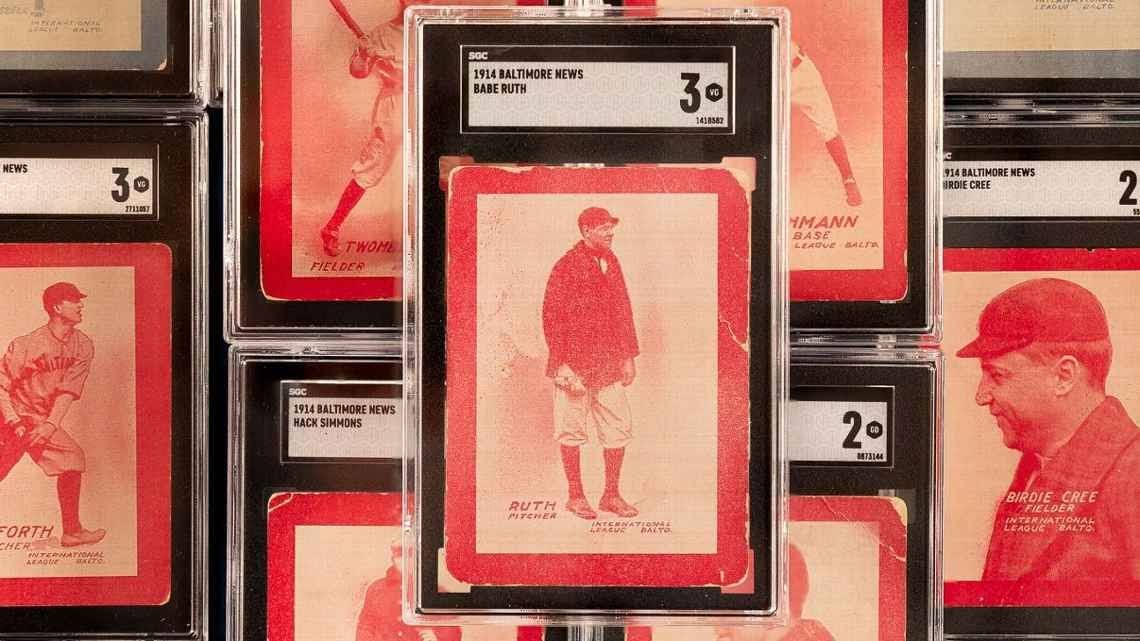
3. 1914 Baltimore News Babe Ruth Rookie (SGC 3) — $7.2 Million
Where: Robert Edward Auctions ·
When: December 2023
Babe Ruth's true rookie card — not the more famous 1933 Goudey, but a 1914 minor-league card depicting a 19-year-old Ruth as a pitcher for the Baltimore Orioles of the International League. At the time of sale, it was the highest-priced Babe Ruth item ever and the third-highest trading card sale in history. This SGC 3 (VG) is the second-highest-graded of roughly ten known examples.
The provenance is almost impossibly clean: the card was collected in 1914 by a Baltimore paperboy named Archibald Davis, stayed in the Davis family for more than a century, and was displayed at the Babe Ruth Birthplace and Museum from 1998 to 2023. REA president Brian Dwyer called it "the most significant baseball card ever produced."
What Collectors Should Know: This exact card resold at Heritage in October 2025 for just $4.02 million — a roughly $3.18 million loss in under two years, believed to be the largest dollar loss ever realized on a single trading card, and a hard warning that even grail-level cards are not guaranteed one-way investments.
Image: 1914 Baltimore News Babe Ruth rookie — credit: ESPN
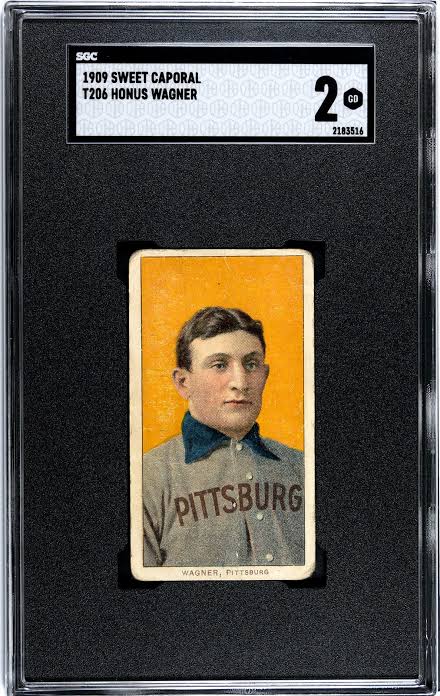
2. 1909–11 T206 Honus Wagner (SGC 2) — $7.25 Million
Where: Goldin (private sale)
When: August 2022
The highest verified price ever paid for the card collectors call the "Mona Lisa" of the hobby. Graded SGC 2 (Good) — a reminder that with a card this scarce, condition is almost secondary to simply owning one. Both buyer and seller stayed anonymous. This sale briefly reclaimed the "most expensive sports card" title before the Mantle at #1 took it back weeks later.
The Wagner legend is built on scarcity. The T206 set was issued 1909–1911 by the American Tobacco Company, and Wagner's card was pulled almost immediately — theories range from Wagner objecting to marketing tobacco to children, to an early stand for fair compensation for his likeness. Robert Edward Auctions estimates the total known population at roughly fifty; population trackers current to 2026 count about 53 graded across PSA and SGC combined.
What Collectors Should Know: Individual Wagners carry their own histories — "The Gretzky" (once owned by Wayne Gretzky, later revealed to have been trimmed) and the "Jumbo Wagner" among them — so with this card, the specific example's story is as important as the name on the front.
Image: T206 Honus Wagner (SGC 2) — credit: ESPN
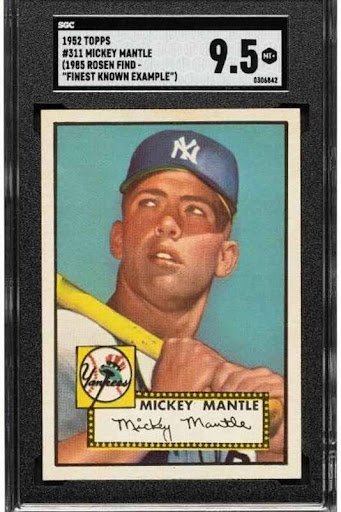
1. 1952 Topps Mickey Mantle #311 (SGC 9.5) — $12.6 Million
Where: Heritage Auctions
When: August 2022
The most expensive vintage baseball card ever sold. Graded SGC 9.5 (Mint+), it's considered the finest known example of the card; SGC has never graded one a 10.
This is arguably the best-documented card in the entire hobby. It came from "The Famous 1952 Topps Find" — a hoard of roughly 5,500 mint 1952 Topps cards that dealer Alan "Mr. Mint" Rosen bought in the mid-1980s from a Massachusetts family. Rosen sold this Mantle, bought it back, then in 1991 sold it to consignor Anthony Giordano for $50,000 along with a signed letter calling it the finest known example in the world. Giordano kept it hidden and ungraded for about 30 years before consigning it to Heritage. Chris Ivy, Heritage's director of sports auctions, said an eight-figure result would have been "the stuff of fantasy just a decade ago."
What Collectors Should Know: The $12.6 million price included a 20% buyer's premium, and while it remains the vintage baseball record as of 2026, the overall trading card record has since passed to a modern basketball card — a signal of exactly where market momentum is heading.
Image: 1952 Topps Mickey Mantle #311 (SGC 9.5) — credit: ESPN
The Future of Baseball Card Collecting
If baseball built the hobby, an obvious question follows: Does it still lead it? The 2025–2026 data gives a complicated answer.
The overall market is booming — but not for baseball. Grading hit a record 26.8 million cards across the major services in 2025, up 32% year-over-year per GemRate. But that surge was driven by trading card games like Pokémon, not sports. Sports-card grading actually fell about 12%, and baseball specifically dropped 14%. The "grading boom" headline hides a real softening in baseball submissions, but that does not stop modern baseball cards from pulling 7-figures by players like Ohtani and Judge. Although grading submissions is down, sales aren't.
Vintage is consolidating around trophy names. Card index data showed modern and ultra-modern cards posting bigger percentage gains than vintage in 2025. Blue-chip vintage — Mantle, Wagner, Ruth, Mays, Robinson — remains globally liquid and strong, but mid-tier and fringe pre-war material has seen a genuine liquidity crunch. Value didn't leave vintage; it concentrated at the very top. The $3.18 million loss on the Baltimore News Ruth is the clearest evidence that even grails can correct hard.
Fanatics reshaped the modern supply chain. Fanatics acquired Topps' trading card business for nearly $500 million in 2022 and has consolidated the exclusive MLB, NBA, and (from 2026) NFL card licenses — ending the market structure that defined the hobby for decades and dramatically growing Topps' revenue in the process.
Where it's heading. Expect a larger, more institutionalized hobby: professional grading as the default, fractional-ownership platforms, live-stream commerce, and continued concentration of value in the highest-grade, best-provenance examples of the most iconic names. For vintage baseball specifically, the trophy cards on this list look more durable than almost anything else in the market — but the era of buying any old card and watching it climb is over.
The hobby of baseball is bigger than ever. It's just no longer only about baseball.
Final Thoughts
Every card on this list is a first — the first modern set, the first true Ruth rookie, the tobacco card that started it all. That's the deeper reason vintage baseball cards command these prices: they're not just rare cardboard, they're the foundation the entire hobby was built on. Football, basketball, hockey, and even Pokémon collectors are all, in a sense, playing a game that baseball invented.
The market will keep shifting. Modern cards are outrunning vintage on momentum, Fanatics is reshaping the supply chain, and even seven-figure grails can lose value fast. But the icons endure. Whatever you collect, the principles are the same everywhere: know the condition, verify the rarity, and document the provenance.
If you're sitting on a collection you've never fully cataloged, start there. Capture every card, every grade, every set, then let the market data tell you what's worth grading, holding, or moving. Collectibles.com is purpose-built to do exactly that — scan, organize, value, and showcase your entire collection from your phone, alongside a community that shares your passion for the hobby.
Download our IOS App
Download our Android App

Frequently Asked Questions
What is the most expensive baseball card ever sold?
A 1952 Topps Mickey Mantle #311 graded SGC 9.5 sold for $12.6 million at Heritage Auctions in August 2022. It remains the vintage baseball card record as of 2026 and was, at the time, the most valuable sports collectible ever sold.
Why is the T206 Honus Wagner so valuable?
Extreme scarcity. The card was pulled from production almost immediately after its 1909–1911 release, leaving only about 50 known examples. Combined with Wagner's Hall-of-Fame status and the card's near-mythical reputation, that scarcity has made it the "Mona Lisa" of trading cards — the highest verified sale is $7.25 million.
Did football and basketball cards come before or after baseball cards?
After. Baseball cards originated as tobacco inserts in the 1860s–1880s and established the entire format — tobacco cards, then gum cards, then the modern 1952 Topps template. Football, basketball, and hockey card sets all followed the model baseball had already built.
Is baseball card collecting still growing in 2026?
The overall trading card hobby is booming — grading hit a record 26.8 million cards in 2025 — but that growth is driven mainly by Pokémon and other trading card games. Sports-card grading, including baseball, actually declined in 2025, and value in vintage baseball is consolidating around the most iconic names.
What makes a vintage baseball card worth millions?
The Big Three: condition (a high grade from PSA or SGC can multiply value many times over), rarity (short prints, pulled cards, and low surviving populations), and provenance (documented ownership history and named-collection pedigree). The record-setters on this list score high on all three.
Disclaimer: All content on Collectibles.com and shared publicly is for educational and informational purposes only and does not constitute investment, financial, tax, or legal advice. Collectibles.com and its partners are not registered investment advisors. Investing in collectibles carries a high risk of loss, including total loss of principal, and is speculative and unsuitable for many investors. Past performance is no guarantee of future results. Always consult qualified professionals before making decisions. No recommendations or solicitations are intended.
Written by Dillan Prince.

