

Collectibles.com is home to collectors across every category — and philately (the 5th most added collectible on our app) is one of the oldest and the world's most widely practiced collecting hobbies. With rare stamps regularly crossing six and seven figures at the world's top auction houses, we dug into the data: what are the most valuable stamps ever sold, what makes them worth that much, and what should serious collectors actually know about each one?
If you're sitting on a stamp collection, albums you haven't opened in years, or individual stamps you can't identify, the first move isn't selling — it's cataloging. Document what you have, then let market data tell you what's worth expert authentication, what's worth holding, and what's worth letting go. — Collectibles.com
Why These Stamps Sell for 6 to 7-figures?
Six- and seven-figure philatelic sales don't happen because old stamps are inherently valuable. They happen when these five factors align.
Printing errors create instant rarities: The Treskilling Yellow, the Sicilian Error of Colour, the Whole Country Is Red, and the Inverted Jenny all exist because of mistakes that slipped past quality control too late to eliminate every surviving copy. Error stamps are the rarest class in philately because they were never supposed to exist.
Emergency and provisional issues are functionally unique: A newspaper office printed the British Guiana 1-Cent Magenta because the colony couldn't wait for stamps to arrive from England. That improvised origin is the entire reason it became the most famous stamp in the world.
Cover context multiplies value dramatically: A stamp on its original envelope — with postmark, address, and accompanying stamps intact — is a fundamentally different object from a loose example of the same issue. The Mauritius "Ball" cover holds the all-time philatelic record precisely because of what surrounds the stamp, not just the stamp itself.
Named-collection provenance is the authentication floor: Every record-setter below traces back to a documented source. In a category where forgeries have circulated for over a century, named collections and expert certificates aren't optional — they're what separates a story from a sale.
Third-party expertization transformed the market: Philatelic Foundation certificates, Royal Philatelic Society opinions, and auction house expertization gave collectors a standardized authentication language — exactly as PSA transformed sports cards and CGC transformed comics. A "magenta octagonal stamp" is a claim. A "BG 1856 1c, PF-certified, ex-DuPont" is comparable.
Now let's get into the list!
The 10 Most Valuable Stamps Ever Sold
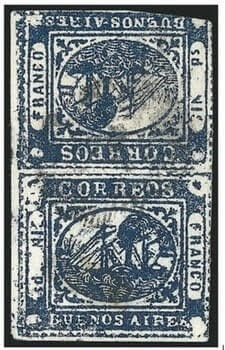
10. Buenos Aires 1p "In Ps" Tête-Bêche Pair, 1859 — $575,000
Where: Robert A. Siegel When: June 2008
There is exactly one of these in existence. The Buenos Aires tête-bêche pair [tête-bêche: a pair of stamps printed so that one appears inverted relative to the other] is the only surviving example of this printing error from the State of Buenos Aires — it originally cost one peso, and it sold for $575,000 at Siegel in 2008. The auction house called it simply "one of the world's great philatelic rarities." The description fits.
What Collectors Should Know: The tête-bêche format here was a printing accident, not a design choice, making this the only documented survivor of a mistake that was never meant to leave the press.
The Buenos Aires 1859 1p tête-bêche pair, the only known example - image courtesy of MyNation
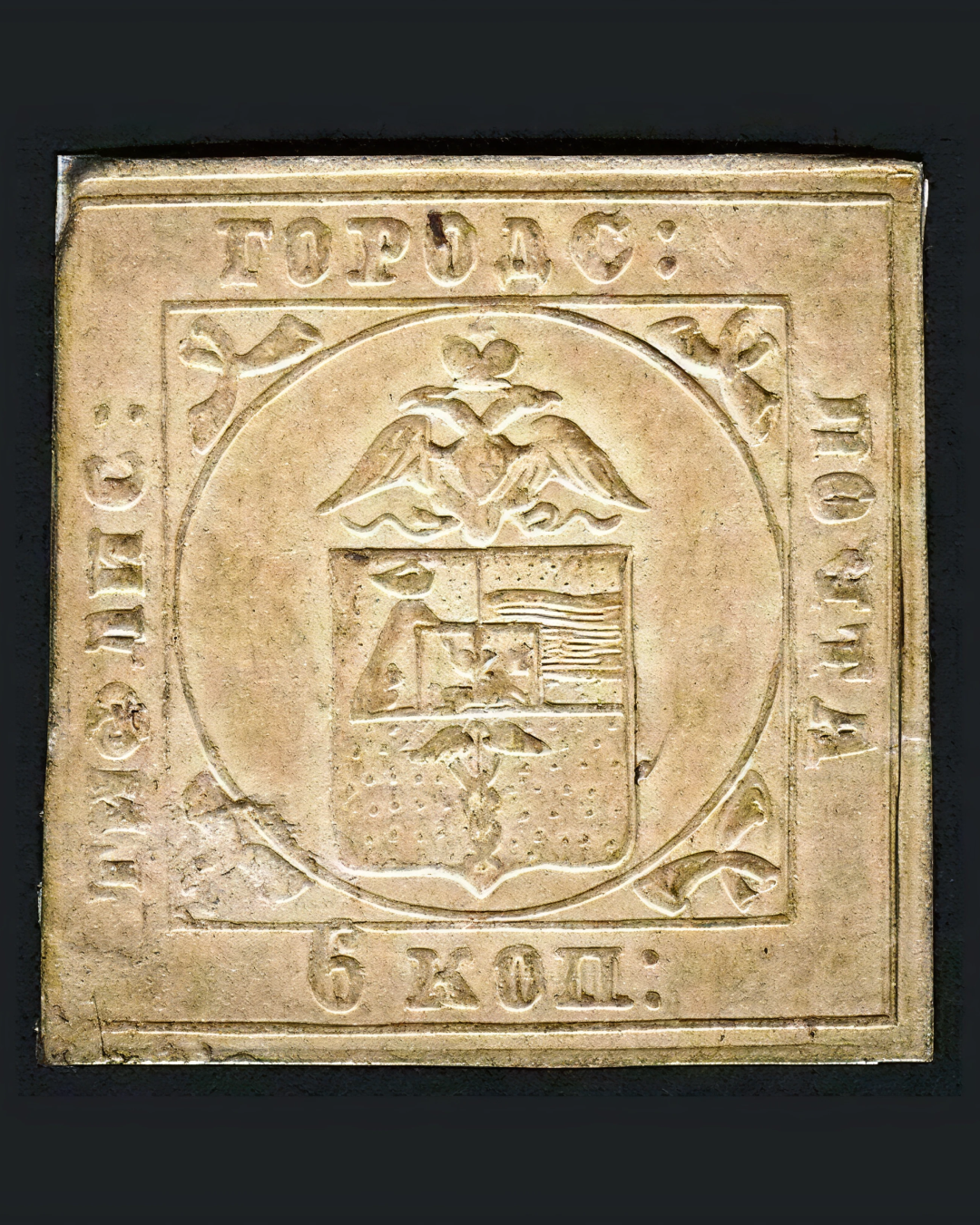
9. Tiflis Stamp, 1857 — $228,000 - $700,000+
Where: David Feldman, 2008 / Spink, 2017
Issued in the Russian Empire in 1857, the Tiflis Unique is considered the first Russian postage stamp.One sold at David Feldman in 2008 for over $700,000. A more recently discovered example ( kept undisturbed in an album in New Zealand for roughly a century) appeared at Spink in October 2017, where it sold for approximately $228,000. The gap between those two figures isn't a contradiction; it's a lesson in how dramatically condition and documentation affect individual sale prices within the same issue.
What Collectors Should Know: If a single stamp can show a $500,000 variance between known examples, imagine what that means for issues where the surviving population runs into the dozens.
The 1857 Tiflis Unique, considered the first Russian postage stamp, has only five known surviving examples - Image courtesy of Mintage World
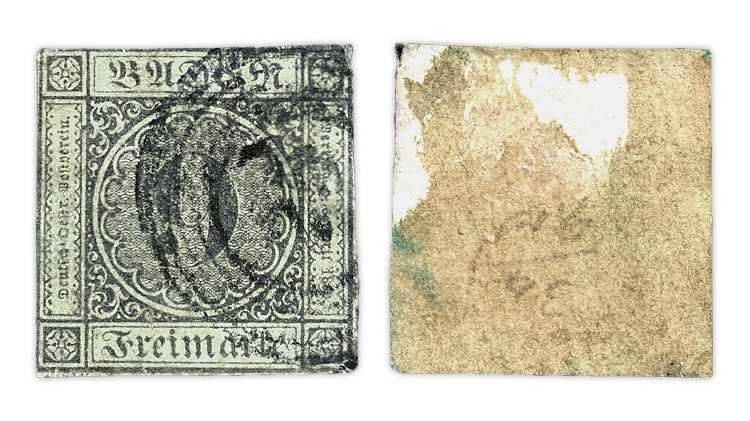
8. Baden 9 Kreuzer Error, 1851 — $1.5 - 1.7 Million
Where: David Feldman, April 3, 2008 / Heinrich Koehler, June 2019
Only four specimens of the Baden 9 Kreuzer error are known to exist. The stamp was meant to be printed in pink; a small number of sheets were accidentally produced in green after the printer used the wrong plate. The record example sold for $1,545,000 at David Feldman in 2008. A cover franked with the same error stamp, from the estate of German-born businessman Erivan Haub, sold at Heinrich Koehler in June 2019 for approximately $1.73 million.
What Collectors Should Know: Both record sales of this stamp came with named-collection provenance. Anonymous provenance on a four-known-copy error is a significant authentication risk.
The Baden 9 Kreuzer error stamp of 1851 is one of only four known examples - image courtesy of Linns Stamp News
7. The Whole Country Is Red, China 1968 — $2 Million
Where: China Guardian, Beijing When: November 23, 2018
Issued during the Cultural Revolution, this stamp was withdrawn almost immediately after it was discovered that the island of Taiwan had been left uncolored — a politically charged error on a stamp explicitly celebrating Mao's communist revolution. The surviving population is unknown, but confirmed examples are extremely rare. The record sale of 13.8 million yuan (approximately $2 million) was achieved at China Guardian in November 2018. An earlier example sold at InterAsia in 2015 for $445,103, and another in December 2018 for $1.15 million — three sales within a few years, each with a different result depending on condition and buyer competition.
What Collectors Should Know: Political context is inseparable from this stamp's value. It's simultaneously a philatelic error and a document of one of the most consequential periods in 20th-century Chinese history.
China's 1968 "Whole Country Is Red" stamp, quickly withdrawn after Taiwan was left uncolored - image courtesy of OSU.Edu

6. Inverted Jenny, USA 1918 — $2 Million
Where: Robert A. Siegel When: November 8, 2023
The most recognizable stamp error in American philately, and the entry on this list is most likely to appear in a non-collector's general knowledge. The Inverted Jenny features a Curtiss JN-4 biplane printed upside down — the result of a Washington, D.C., post office clerk selling a sheet of 100 stamps with the misprint before the error was caught. Most copies were pulled; the 100 that survived have been among the most tracked philatelic items in the world ever since. The record sale of $2,006,000 (including buyer's premium) was achieved at Robert A. Siegel on November 8, 2023, for Jenny Invert Position 49.
What Collectors Should Know: Individual Inverted Jenny values vary significantly based on sheet position — centered, mint never-hinged examples command the strongest premiums, and position within the original sheet of 100 is documented and tracked by the philatelic community.
The 1918 Inverted Jenny, the most famous American stamp error featuring a Curtiss JN-4 biplane printed upside-down, sold for $2,006,000 at Siegel in 2023 - image courtesy of BBC

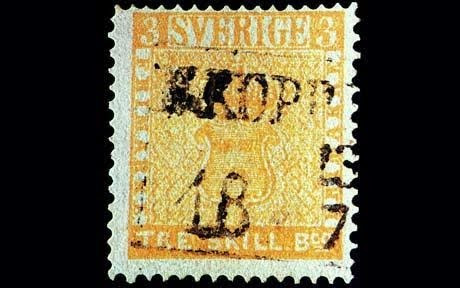
5. Treskilling Yellow, Sweden 1855 — ~$2.3 Million
Where: David Feldman, May 2010 (price undisclosed, estimated ~$2.3M) / Private sale, May 2013
The Treskilling Yellow is the only known example of its kind. The Swedish 1855 issue was produced in green; this single stamp exists because of a printing error that substituted yellow. It was rescued from a rubbish bin in 1885 by a schoolboy named Georg Wilhelm Baeckman, who sold it to a dealer for seven Kroner n 1990, it fetched $1.3 million; iit has since passed through some of philately's most prominent auctions and is estimated to have sold for $2.3 million. Its last known transaction resides in the private collection of Swedish nobleman Count Gustaf Douglas.
What Collectors Should Know: One known copy in the world doesn't automatically mean the highest price in the world — the entries above it on this list make that clear. Cover context and narrative depth still do significant work at the very top of the market.
The Treskilling Yellow is the only known example of the 1855 Swedish printing error - image courtesy of LUXEO
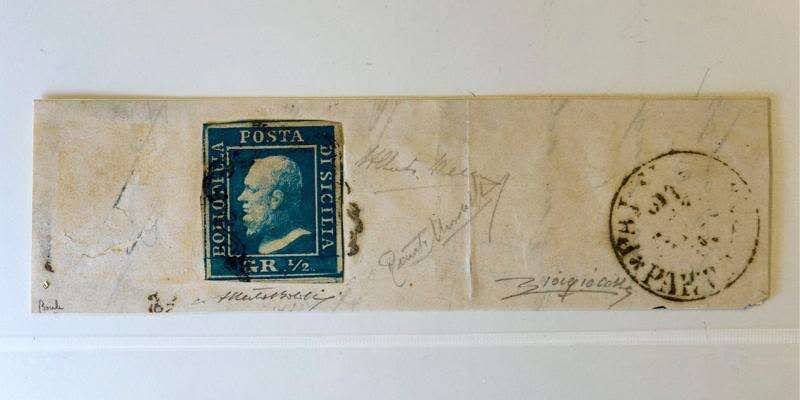
4. The Sicilian Error of Colour, 1859 — $2.6 Million
Where: Dreyfus Sale When: June 10, 2011
Only two examples of the Sicilian Error of Colour are known to exist. The stamp was produced as part of Sicily's 1859 issue and intended to be printed in yellow; a small number were produced in blue instead. Both stamps were first exhibited at the Manchester Philatelic Exposition in 1899, then separated at some point before a private treaty sale in Switzerland. The record example sold for approximately $2.6 million at the Dreyfus sale in June 2011, to an online bidder described as based in France.
What Collectors Should Know: Two known copies are one of the most precisely documented surviving populations in philately. That certainty is itself part of the value — no ambiguity about what "rare" means here.
The Sicilian Error of Colour, 1859 — one of only two known examples - image courtesy of The Daily Herald
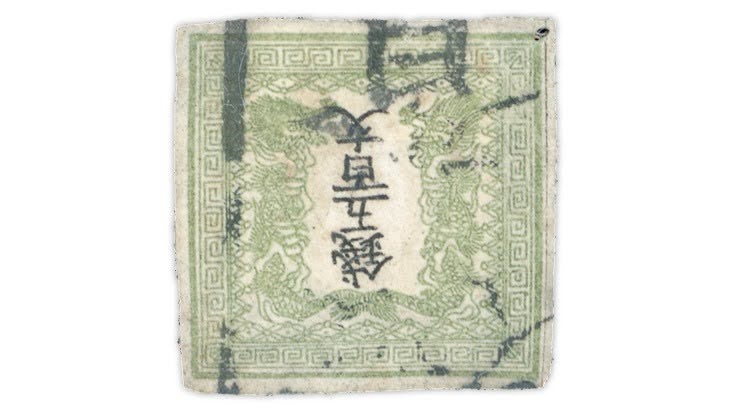
3. Japan 500 Mon Inverted Center, 1871 — ~$6.1 Million
Where: David Feldman International | When: June 3, 2023
Japan's first postage stamps appeared in 1871, featuring a dragon design surrounding the "mon" denomination at the center. Somewhere in that first print run, one sheet went wrong — the center value on a 500 mon stamp was printed inverted. The error went undetected for over a century until an American collector uncovered it in 1973, at which point it was immediately recognized as the cornerstone of Japanese philately. Its value climbed from $75,000 at that first sale to millions over the following five decades.
When it finally returned to auction in June 2023 at David Feldman (its first public sale since 1973), it sold for 5.4 million EUR to a phone bidder from Asia, setting the record as the most valuable stamp ever sold from the Asian continent.
What Collectors Should Know: Fifty years between public sales is not unusual for stamps at this level. When a major rarity returns to market after decades, the next sale tends to reset the price significantly — as this one did.
Japan's 1871 500 Mon Inverted Center stamp, Asia's most valuable stamp - image courtesy of Linns Stamp News
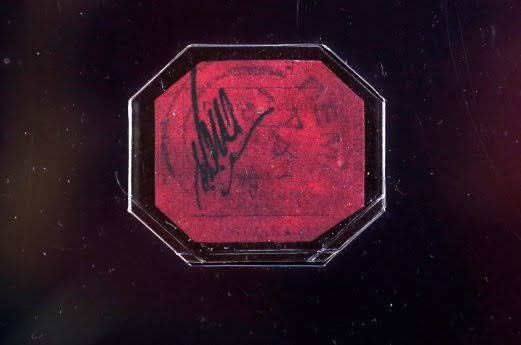
2. British Guiana 1-Cent Magenta, 1856 — $9.4 Million
Where: Sotheby's, New York | When: June 2014
For most of philatelic history, this was the undisputed #1 — and it remains the most famous single stamp in the world. In 1856, the colony of British Guiana ran short of stamps and couldn't wait for a fresh supply from England. The local postmaster commissioned the publishers of the Official Gazette to print an emergency issue: crude octagonal designs in black ink on magenta paper, each initialed by a post office employee as an anti-forgery measure.
It was discovered in 1873 by a 12-year-old boy in his family's attic. He sold it for a small sum. It passed through some of the most prominent collections in philatelic history before selling at Sotheby's in June 2014 for $9.48 million. When it returned to Sotheby's "Three Treasures" sale in June 2021 (estimated at $10–15 million), it realized $8.3 million, the first time the stamp had ever sold for less than its previous hammer price.
What Collectors Should Know: This is the only known example, with a fully traceable ownership chain from a 12-year-old's attic to Sotheby's. That combination — absolute uniqueness plus complete provenance is the gold standard in any collecting category.
The British Guiana 1-Cent Magenta of 1856, the world's most famous stamp - image courtesy of New York Times
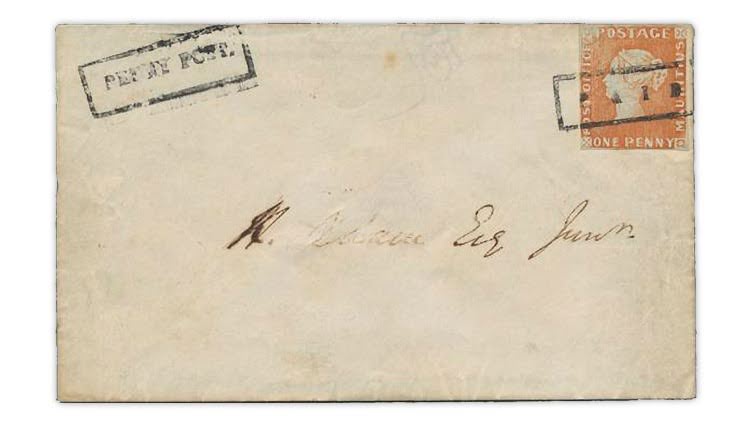
1. Post Office Mauritius "Ball" Cover, 1847 — ~$12 Million
Where: Christoph Gärtner When: June 2021
The record holder in philately. Fewer than 30 individual copies of the Post Office Mauritius stamps are believed to have survived, with loose examples valued at $600,000 or more depending on condition. But the number that defines this issue is $12 million — the highest price ever paid for a single philatelic item.
It wasn't the first Mauritius cover to set a record. The "Bordeaux" cover bearing both the one penny orange-red and two pence deep blue sold for $3.8 million in 1993. The "Bombay Cover" fetched €2.4 million at David Feldman in 2016. Three separate covers. Three separate records. All built around the same 1847 issue.
The "Ball" cover edges out the British Guiana on verified hammer price alone — but both represent the absolute ceiling of the global stamp market, and both are effectively irreplaceable. The difference at the very top comes down to cover context: the Mauritius penny red-orange in exceptional condition, on its original envelope, with documented history reaching back to a ball invitation from the 1840s, produced the highest number ever recorded for a philatelic item at public auction.
What Collectors Should Know: No entry on this list demonstrates the power of cover context more forcefully. The stamp alone is worth hundreds of thousands. The stamp on its original envelope, with postmark intact, is worth millions more.
The 1847 Post Office Mauritius "Ball" cover, sold for approximately $12 million - image courtesy of Linns
Honourable Mentions: Three U.S. Stamps Worth Knowing
2c George Washington Carmine Vertical Coil Pair, 1908 — $1.47 Million
Where: Robert A. Siegel | When: April 2021
Only five pairs of the 1908 George Washington 2c carmine vertical coil are believed to exist, placing it amongst the most important rarities in U.S. philatelic history. One pair is held in the Miller Collection at the New York Public Library. The April 2021 Siegel sale achieved $1,475,000, more than quadrupling its 2002 Spink sale price of $325,000.
Alexandria "Blue Boy," 1847 — $1.1 Million
Where: H.R. Harmer | When: June 22, 2019
Seven Alexandria provisional stamps survive; almost all are buff or brownish-yellow. Only one is blue. It's attached to a letter written by James Hoof to Janette Brown against her family's wishes — a letter meant to be destroyed that was found decades later in Janette's sewing box. It sold for $1.18 million in 2019. Even without the philatelic rarity, the provenance story alone would make it collectible.
15c Abraham Lincoln Z Grill, 1867 — $1.4 Million
Where: Cherrystone When: July 2019
One of the star lots of Cherrystone's "New Amsterdam Collection of United States Rarities" sale, the 1867 15c Lincoln Z Grill sold for $1,400,000 in July 2019. The same sale surfaced several other major U.S. rarities simultaneously — one of the more significant single auction events in American philately in recent memory, and a reminder that named-collection sales are where records get made.
Final Thoughts
The most valuable stamps ever sold share one trait: they almost didn't make it. Emergency printings that were never meant to outlast their immediate use. Printing errors that quality control almost caught in time. Covers that should have been discarded and weren't. The survivors (authenticated, documented, and preserved across a century or more) are what serious philatelic collections are built from.
If you're sitting on an inherited collection, albums you haven't properly cataloged, or individual items you can't identify, the first move isn't selling — it's documenting what you have. Capture every stamp, every cover, every album page in an organized inventory, then let market data tell you what's worth expert authentication, what's worth holding, and what's worth letting go.
Collectibles.com is purpose-built to do that for you, with just a few taps on your smartphone — use our app to easily identify, value, and showcase your collection in one place, with a community that shares the obsession.
Interesting Facts:
What is the most valuable stamp ever sold?
The Post Office Mauritius "Ball" cover sold at Christoph Gärtner in June 2021 for approximately $12 million — the highest price ever paid for a single philatelic item. For a loose stamp not on cover, the British Guiana 1-Cent Magenta holds the record at $9.48 million (Sotheby's, 2014).
What makes a stamp worth millions of dollars?
Rarity (printing errors, provisional issues, or near-total destruction of surviving examples), condition (mint examples of 19th-century stamps are exponentially scarcer than used or damaged ones), and provenance (documented ownership history, expert certification, and original cover context).
Does it matter if a stamp is on its original envelope?
Significantly. The Mauritius "Ball" cover sold for approximately $12 million; individual loose Mauritius stamps sell for $600,000 or more. Cover context — the original envelope with postmark and accompanying stamps intact — can multiply value several times over a loose example of the same issue.
How do I know if a rare stamp is authentic?
Third-party expertization through recognized philatelic bodies — the Philatelic Foundation (U.S.), the Royal Philatelic Society London, or major auction house certification — is the authentication baseline for any serious purchase. Named-collection provenance adds a further layer of verified history.
Where are the most valuable stamps sold?
Robert A. Siegel, Sotheby's, David Feldman SA, Christoph Gärtner, Spink, Cherrystone, and H.R. Harmer account for the majority of record-setting philatelic sales. Private treaty sales through specialist dealers represent a significant share of high-value transactions that never appear in public auction records.
Whether you're just starting the hobby or already on your way to building a serious collection, Collectibles.com offers a super app to easily organize, manage, value, and showcase everything you own — all at your fingertips.
### Download our IOS App
### Download our Android App

Disclaimer: All content on Collectibles.com and shared publicly is for educational and informational purposes only and does not constitute investment, financial, tax, or legal advice. Collectibles.com and its partners are not registered investment advisors. Investing in collectibles carries a high risk of loss, including total loss of principal, and is speculative and unsuitable for many investors. Past performance is no guarantee of future results. Always consult qualified professionals before making decisions. No recommendations or solicitations are intended.

