

Collectibles.com Unscripted — featuring Rob Martinez, Chief Visionary Officer of Audio Media Grading (AMG)
One night, Rob Martinez took a shot in the dark. He DMed Steve Aoki two paragraphs on Instagram — who he was, his vision for a company that didn't exist yet, and a couple of crude notebook sketches — then assumed it would vanish into a celebrity's flooded inbox. Thirty minutes later, his phone buzzed: Steve Aoki has just messaged you. The first reply was blunt. "Are you real? Is this really something you're capable of doing?" It was. That DM became Audio Media Grading.
Fig 1: Robbo from AMG with Steve Aoki

Physical media is quietly disappearing — magazines gone from gas-station racks, CDs vanished from checkout aisles — and that scarcity is exactly why collecting Physical Music has become one of the most exciting corners of the hobby. When something stops being made, the copies that survive start to matter: the sealed cassette, the first-pressing record, the demo tape that was never meant to leave a studio. AMG — which Rob built with co-founders Ken Black and Aoki, after a record-convention argument over a seller's self-assigned grade convinced him the hobby needed an unbiased referee — grades all of it: vinyl, cassettes, CDs, 8-tracks, reels. "It's a one-stop shop for music grading," he says. So when Rob tells you how to start, he's both a lifelong collector and the person who decides what your record — or tape, or disc — is worth.
Where to Start Collecting Physical Music
You have two honest paths, and Rob frames them exactly like sports cards.
The first is modern. Walk into your local record store and head for the back wall, where the vintage and high-priced pieces live. What you're hunting is a first pressing, sealed, of an artist's debut — whether that's an LP, a cassette, or a CD. Physical Music, like cards, is priced on performance: proven legends are your "blue chip stocks," while a brand-new artist is a rookie bet. You can buy a debut from a buzzy newcomer like Gracie Abrams or Ella Langley and gamble on where their career goes — or you can play it safe.
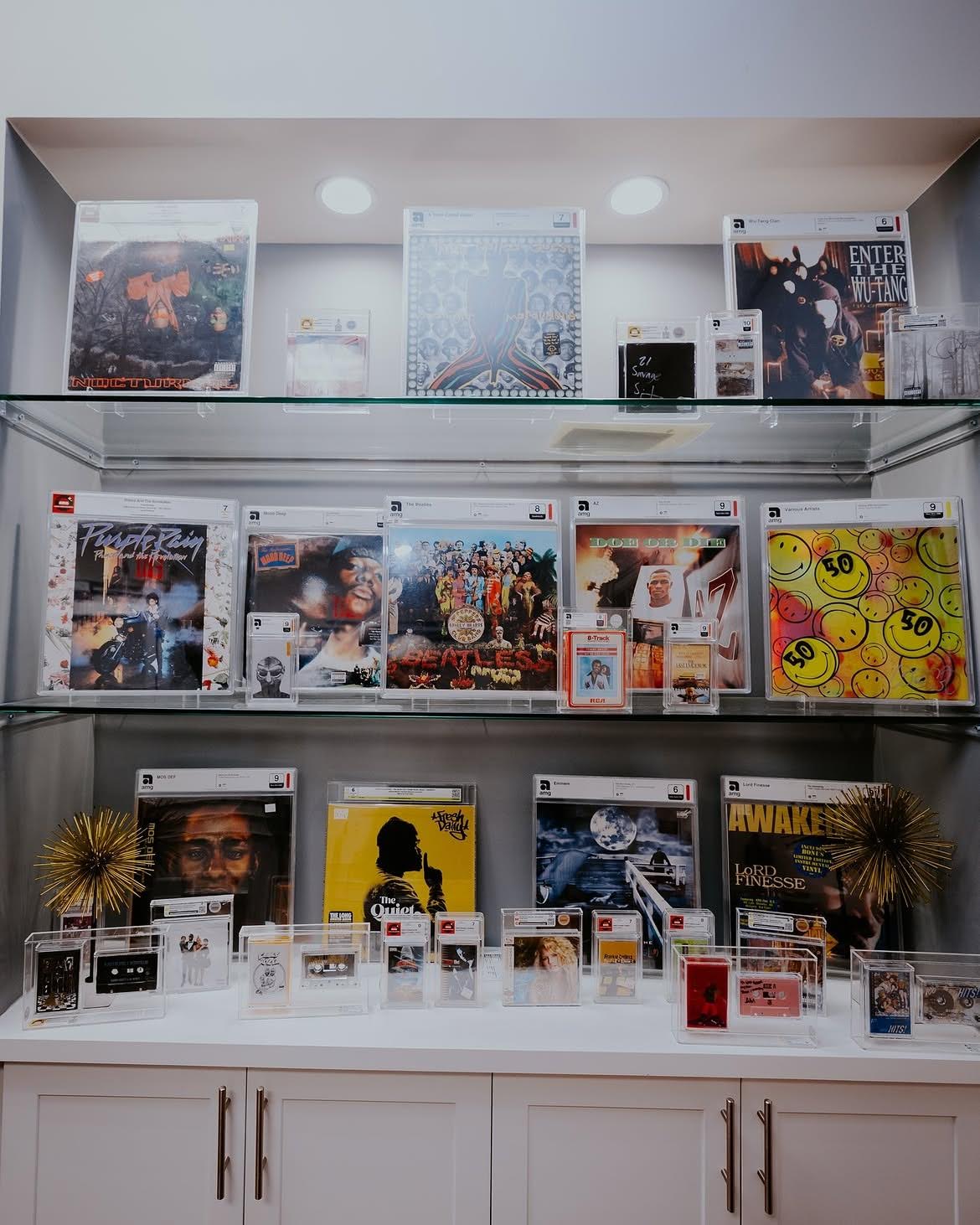
Rob plays it safe, and he plays it vintage. At AMG, he says, "early '90s grunge and hip hop reign supreme." Think Pearl Jam's Ten, Nirvana's Nevermind, Wu-Tang Clan's 36 Chambers, and the first seven solo records that followed. Step back into '80s rock — Metallica, Guns N' Roses — and you're holding what he calls blue-chip stock. The appeal is generational: millennials who grew up on those albums now have disposable income and want them on the shelf. And it's format-agnostic — a sealed first-press cassette of the right title can matter as much as the vinyl.
Fig. 2: Graded CDs and cassettes from AMG HQ
The Collector's Lens: Condition, Rarity, Provenance
Every collectible is judged on the same three things, and Physical Music is no exception.
Condition is where beginners get burned.
On AMG's scale, a scratched seal tanks the grade — which is why Rob says the thing new collectors least expect: a perfect 10 is almost unreachable on anything vintage. "A 9 is our 10," he repeats. So learn to feel cellophane, because resealing is the industry's most common fraud. Cellophane has an era: cigarette-pack-style plastic in the '60s and '70s, a distinct crinkle on '90s cassettes, smooth and thick today. A '90s cassette wrapped in suspiciously smooth plastic is probably a reseal.
Rarity follows the greats
In Rob's shorthand, Beatles records are the Mickey Mantles of the hobby — and the infamous "butcher cover" is the Mantle rookie. Eminem is the modern GOAT, the Ken Griffey Jr. of Physical Music; Taylor Swift is the reigning queen, partly because she signs everything herself with no autopen.
Provenance separates a tape from a relic
This is where AMG's network does the heavy lifting. Send in something like Marilyn Manson's pre-signing demo tape — handed to a Sony executive around 1991 — and it won't be slabbed on your word. AMG traces it back through engineers, managers, and labels, and authenticates signatures through JSA. As Rob puts it, "You gotta give up the games. We're going to find out where it's from."
Provenance isn't a formality — it's what multiplies value. When Steve Perry's camp authenticated and auctioned items from his personal archive through AMG, the sale cleared over $350,000 for his foundation, with pieces that might have sold for $300 jumping to 3,000–5,000 once they carried his signature and a verified story. A separate auction for underground hip-hop figure Mal Kami generated a quarter-million. The lesson for a beginner: a retail album pressed by the millions is worth what it's worth, but an album tied to the artist — a promo copy, a test pressing, a signed personal piece — is in another universe entirely.
Understanding the Grade: The Goldmine Scale
AMG grades every format on a 1–10 numeric scale (like PSA), built on the record world's long-standing Goldmine Standard. Knowing this ladder before you buy is the fastest way to stop overpaying — here's what each tier means for a collector:
Fig 3: AMG’s official grading scale

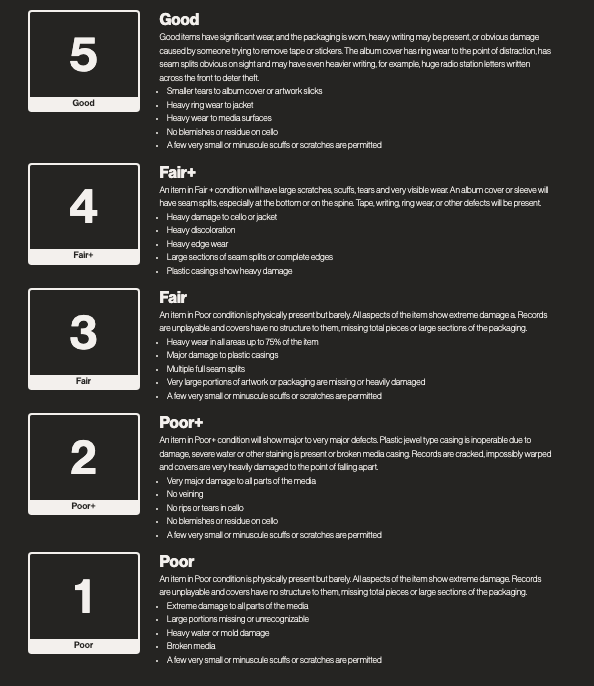
Here's the part beginners underestimate: because any flaw in the cellophane drops a sealed item's grade, Rob says a flawless 10 is nearly unreachable on anything vintage. "A 9 is our 10." One dinged corner in shipping ends the dream. On an '80s title, even a 7 or 8 is worth celebrating.
Three Mistakes New Collectors Make
Rob's most useful advice is what not to do. Avoid these three, and you'll save real money:
- Buying reseals. The single most common trap. Train your hands on cellophane before you spend on anything "sealed."
- Overpaying for reissues. A cheap secondary-market reissue will never command first-pressing money. Know whether you're holding an original or a repress.
- Pre-grading your own stuff. Collectors talk themselves into a grade, then argue when the slab comes back lower. "We are the Goldmine Standard," Rob says. The grade is what it is.
Worth knowing before your first submission: AMG's labels are color-coded — red means sealed, green means open, gray means authenticated, and gold means it carries a signature.
The Golden Rule: Don't Crack the Seal
Here's the question every new collector eventually asks: if you slab a record or tape, you can never play it — so what's the point?
Rob's answer is the best collection of wisdom in the whole conversation. His holy grail is a sealed 1995 cassette of GZA's Liquid Swords, hype sticker intact — a copy he chased for years until one of AMG's own submitters, knowing how much he loved the album, simply sent it to him. Is he going to tear off that cellophane to listen? Of course not. "Just buy another copy," he says — a cheap, open copy you can spin a thousand times. He does exactly this with a first-ever ASAP Rocky mixtape he was handed personally: preserved, never played. You keep the relic sealed and still enjoy the music. It's the same logic as owning one pair of deadstock sneakers and another to actually wear.
Because at the end of the day, a sealed first pressing isn't just an album. It's a piece of music history that happens to have survived — and your job, as its temporary keeper, is to keep it that way.
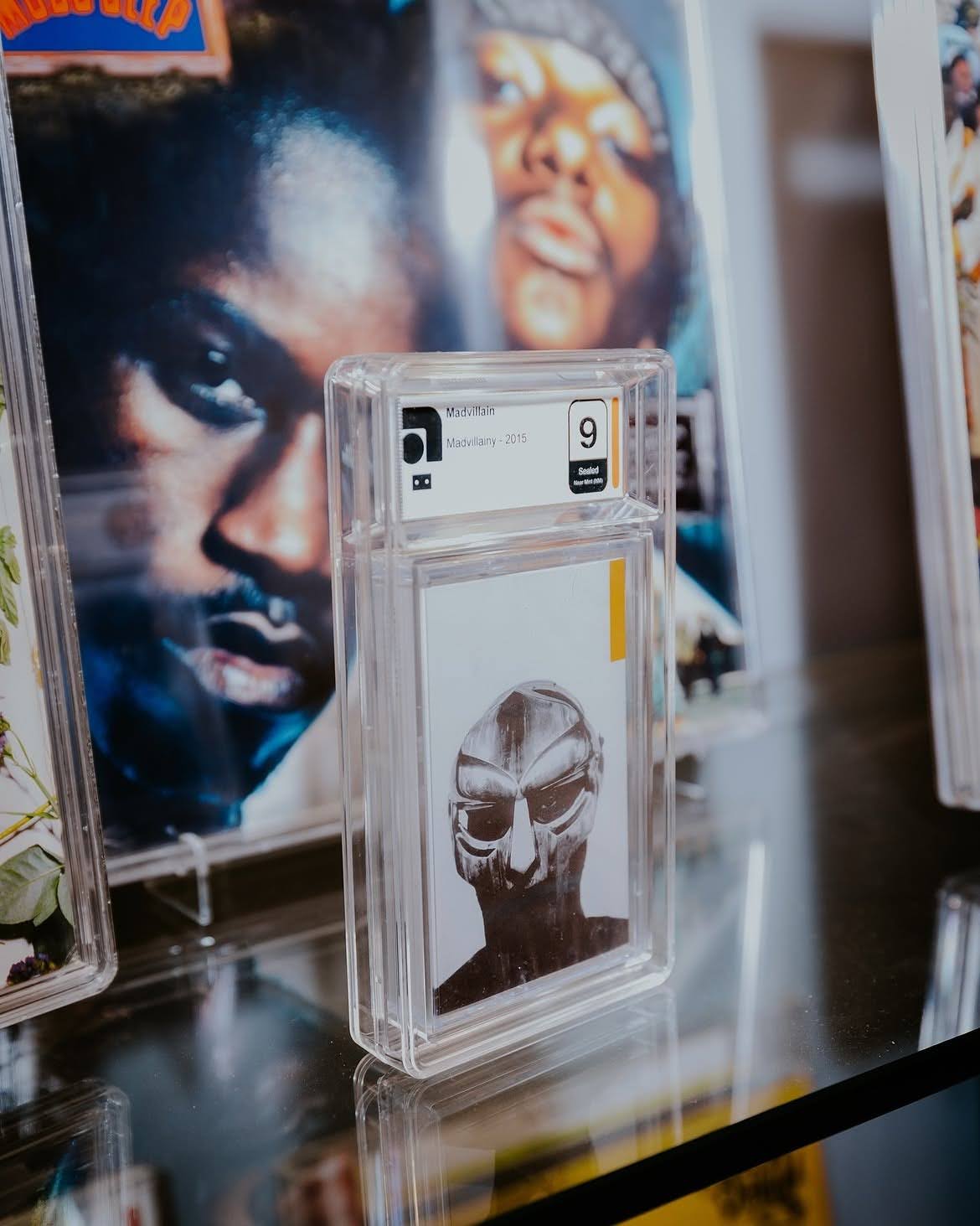
Fig 4: Sealed MF Doom Cassette
Thousands of vinyl, cassette, and CD collectors already catalog and track their collections on the Collectibles.com app — a simple way to know what you own and what it's worth before you ever send it off to grade at AMG. (New to grading in general? See our guide to getting started in sports cards and one collector who forgot a rare card in a drawer for how cataloging pays off.)
Watch the full interview with Rob on our YouTube channel →
Download our iOS App
Download our Android App
Physical Music Collecting FAQ
What's the highest grade I can realistically get?
A 9. On vintage Physical Music, a true 10 is almost impossible, because a single flaw in the cellophane or one dinged corner caps the grade. As Rob says, "a 9 is our 10" — treat a 9 as a home run.
Should I grade an item sealed or opened?
Both have value, and AMG grades both. A sealed copy (red label) carries a scarcity premium but can never be played or verified inside; an opened copy (green label) is graded on its actual condition and playability. Collect sealed for preservation, opened for enjoyment.
Are reissues and repressings worth collecting?
Collect them because you love the music, not as an investment. A modern reissue will seldom command first-pressing money, so don't pay original-pressing prices for one — know which you're holding before you buy.
How do I know if a "sealed" item was resealed?
Learn how cellophane feels by era. A 1990s cassette should have a slight crinkle; if it's wrapped in suspiciously smooth, modern plastic, you may be looking at a reseal done with a cheap heat-sealing machine.
Which formats can actually be graded?
All of them. AMG grades vinyl, cassettes, CDs, 8-tracks, reels, and even minidiscs — plus fully custom display cases for signed showpieces.
Disclaimer: All content on Collectibles.com and shared publicly is for educational and informational purposes only and does not constitute investment, financial, tax, or legal advice. Collectibles.com and its partners are not registered investment advisors. Investing in collectibles carries a high risk of loss, including total loss of principal, and is speculative and unsuitable for many investors. Past performance is no guarantee of future results. Always consult qualified professionals before making decisions. No recommendations or solicitations are intended.

