

For most people, stickers are something you peel and stick — a kid's toy, a giveaway with a cereal box, a tiny piece of paper that doesn't last the week. For serious collectors, stickers are something else entirely: one of the oldest collecting categories in the world, with a six-decade Panini-driven hierarchy, a parallel pop-culture market built by Topps, and individual examples that have sold for over half a million dollars. The most expensive stickers ever sold sit at the intersection of three forces every collector recognizes — condition, rarity, and provenance — and the gap between a $1 sticker and a $555,960 sticker is the same gap that separates a $3 trading card from a $12 million one.
This is the 2026 guide to sticker collecting: where the hobby came from, the five most expensive stickers ever sold, and where the category is heading as digital, premium parallels, and the 2026 World Cup reshape the market.
How sticker collecting became a hobby
The collectible sticker is older than most people assume. By the late 1800s, cigarette manufacturers and chocolate companies were including printed paper inserts and adhesive labels as buyer incentives — early ancestors of the modern sticker, distributed in volumes most modern hobby releases would envy. The 1958 World Cup-era Pelé stickers produced by Swedish chocolate company Alifabolaget are still hunted today, and they predate what most collectors think of as the start of the category.
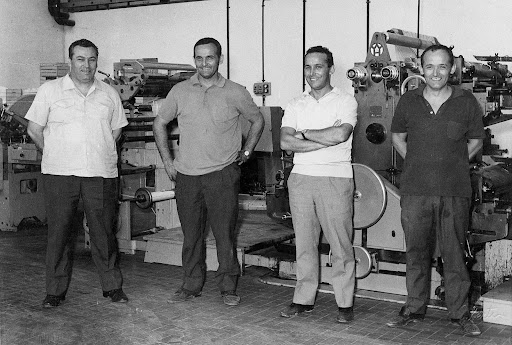
The modern era began in Modena, Italy, in 1961. Brothers Giuseppe and Benito Panini ran a newsstand distribution business and stumbled into a stack of unsold football stickers from a defunct local publisher. They bought the lot, sold through it, and saw the opportunity. That same year, Panini launched its first Calciatori (Footballers) sticker album, covering the Italian league. Within twelve months, the company had sold 15 million packets. The peelable-sticker-with-album format — the one every collector now recognizes — was invented at that table.
The founders of Panini - Image courtesy of Soccercards.ca
Stickers are one of the most under-graded high-end categories in the entire hobby, which means the next record-setter is still sitting in someone's attic, album, or shoebox — unrecognized, unpeeled, ungraded. Catalogue first — The market data will tell you whether you're holding something special. — Collectibles.com
The category's first global moment came in 1970. Panini signed an agreement with FIFA and produced the first-ever FIFA World Cup sticker album for the Mexico tournament. Pelé was the face of the tournament, Brazil won the Jules Rimet Trophy outright, and the Panini World Cup sticker album became a generational ritual. Every two years, the World Cup edition has driven sticker collecting into living rooms across continents.
Non-sports sticker collecting traces its own lineage. Topps launched Wacky Packages in 1967, satirical stickers parodying consumer brands. In 1985, the same company released Garbage Pail Kids — a peelable sticker line that became one of the defining pop-culture phenomena of the 1980s, banned in schools, fought over in lawsuits, and now traded in PSA slabs for thousands of dollars per card. Pokémon stickers, Disney stickers, NBA stickers, and dozens of other licensed lines followed.
By the 2010s, third-party grading services began slabbing stickers the same way they slabbed cards. That single shift — the standardization of condition assessment — opened the floodgates for the modern high-end sticker market. In 2021, a Panini Calciatori Diego Maradona rookie sticker sold for $555,960 at Goldin Auctions. The category has never looked back.
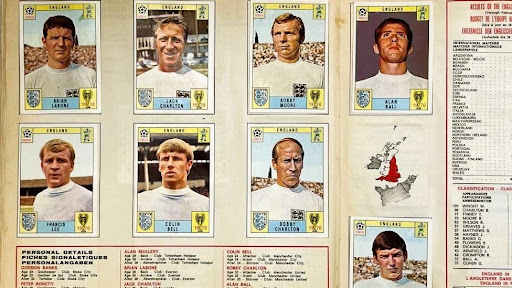
The first soccer stickers ever printed - Image courtesy of BBC
What makes a sticker rare or expensive?
Six-figure sticker sales aren't a quirk: They follow the same three forces that govern every premium collectible category — but stickers carry one additional pressure that makes top-grade survivors even rarer than cards.
The condition is brutal for stickers. A trading card lives in a binder or a top-loader. A sticker was designed to be peeled and pressed onto an album page, often by an eight-year-old. Most stickers were used as intended — meaning the unpeeled, mint-condition survivors that grade at PSA 10 represent a microscopic fraction of original print runs. For the Maradona 1979-80 Calciatori sticker, only 19 of more than 620 PSA-graded examples have ever earned a Gem Mint 10 grade. Fewer than 4 percent.
Rarity is structural: Original print runs varied dramatically by region and era, and the obsolescence cycle for stickers is faster than for cards. Once a World Cup ends, the production line ends with it. Regional variants — Brazilian Glasslite figures, Spanish La Liga releases, Italian Panini Calciatori issues — created tiny survivor populations decades before grading services arrived to count them. The 2014 Panini World Cup black-border Messi sticker that sold for £115,000 was a one-of-a-kind variant Panini produced as a marketing exercise. There is no second copy.
Provenance is the multiplier: and grading is the gateway. A peelable sticker without grading is almost impossible to authenticate at the high end. Counterfeits circulate, restoration is easy to hide, and the difference between a $50 sticker and a $50,000 sticker is invisible to untrained eyes. The rise of PSA, SGC, and BGS sticker grading in the 2010s gave the top of the market a standardized language. Without grading, no one is paying half a million dollars for a piece of peelable paper.
When all three lock in — pristine condition, microscopic surviving population, documented provenance and grading — a $3 sticker stops being a $3 sticker.
The World’s 5 Most Expensive Stickers
5. Pelé-Signed 1970 Mexico FIFA World Cup Panini Album (International Edition) — €12,038
Sold for: €12,000 (~$13,666)
Where: Catawiki
When: Featured auction (Catawiki's most expensive Panini album sale on record)
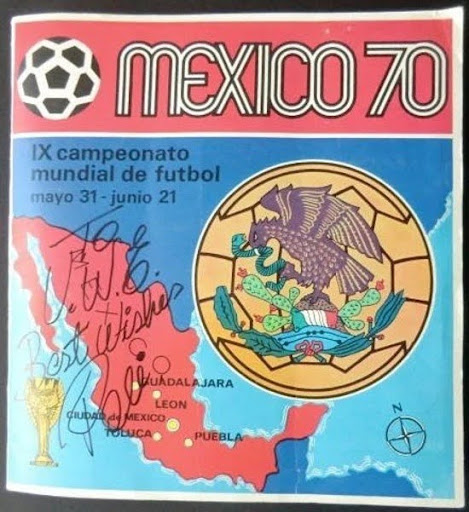
The first-ever Panini FIFA World Cup album was produced for the 1970 Mexico tournament. This particular copy is the international edition, complete with all 271 original stickers — already extraordinarily rare because Panini sold stickers in pairs in 1970, making complete albums genuinely hard to build. What pushed it past every other Panini album on record was the provenance overlay: Pelé signed the cover, then signed his own sticker inside the album, with photographic documentation of the signing.
For sticker collectors, this album is the founding document of the entire World Cup tradition. Every Panini WC release since 1970 traces back to this album, and surviving complete copies are scarce, even unsigned. Signed by the tournament's defining player, this one is effectively unrepeatable.
What Collectors Should Know: The "international edition" designation matters — the standard Italian version of this album sells for roughly a quarter of the international version's price.
Pele, signed 1970 Mexico FIFA World Cup Panini Album - Image courtesy of CataWiki
4. Nasty Nick #1a — 1985 Topps Garbage Pail Kids Original Series 1 (PSA 10) — $17,900
Sold for: $17,900
Where: PWCC Marketplace auction
When: 2021
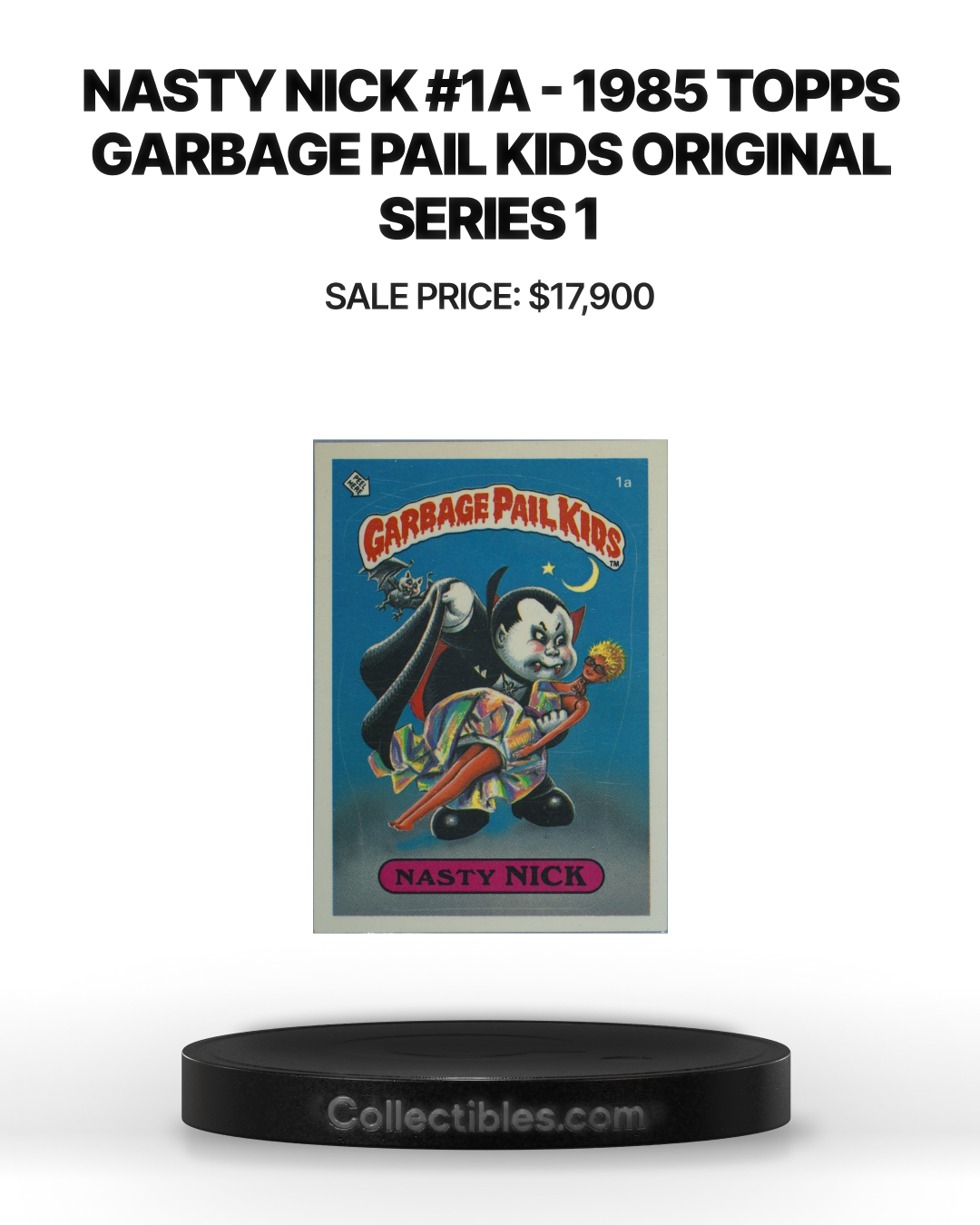
Card #1 in the very first Garbage Pail Kids series. Topps launched GPK in 1985 as a parody of the wholesome Cabbage Patch Kids dolls, and Nasty Nick — depicting a vampire kid biting into a Barbie doll — was literally the first sticker in the set. The PSA 10 example sold by PWCC in 2021 represents the upper ceiling for non-glossy Series 1 GPK examples in pristine condition.
Two factors anchor Nasty Nick's premium. First, the cultural position: as the #1 card in Series 1, this is the GPK equivalent of a Honus Wagner T206 — the founding artifact of the entire franchise. Second, the survival math: Series 1 GPK stickers were sold in $0.25 wax packs, peeled off cards by children, stuck on lunchboxes, ruined by gum, and discarded. Mint condition PSA 10 survivors are vanishingly rare.
What Collectors Should Know: Glossy-back Nasty Nick variants from the earliest print runs sell for considerably more than the standard matte-back examples, though authentication of the glossy variant is critical.
Most Expensive Nasty Nick Sticker - Image courtesy of PSA
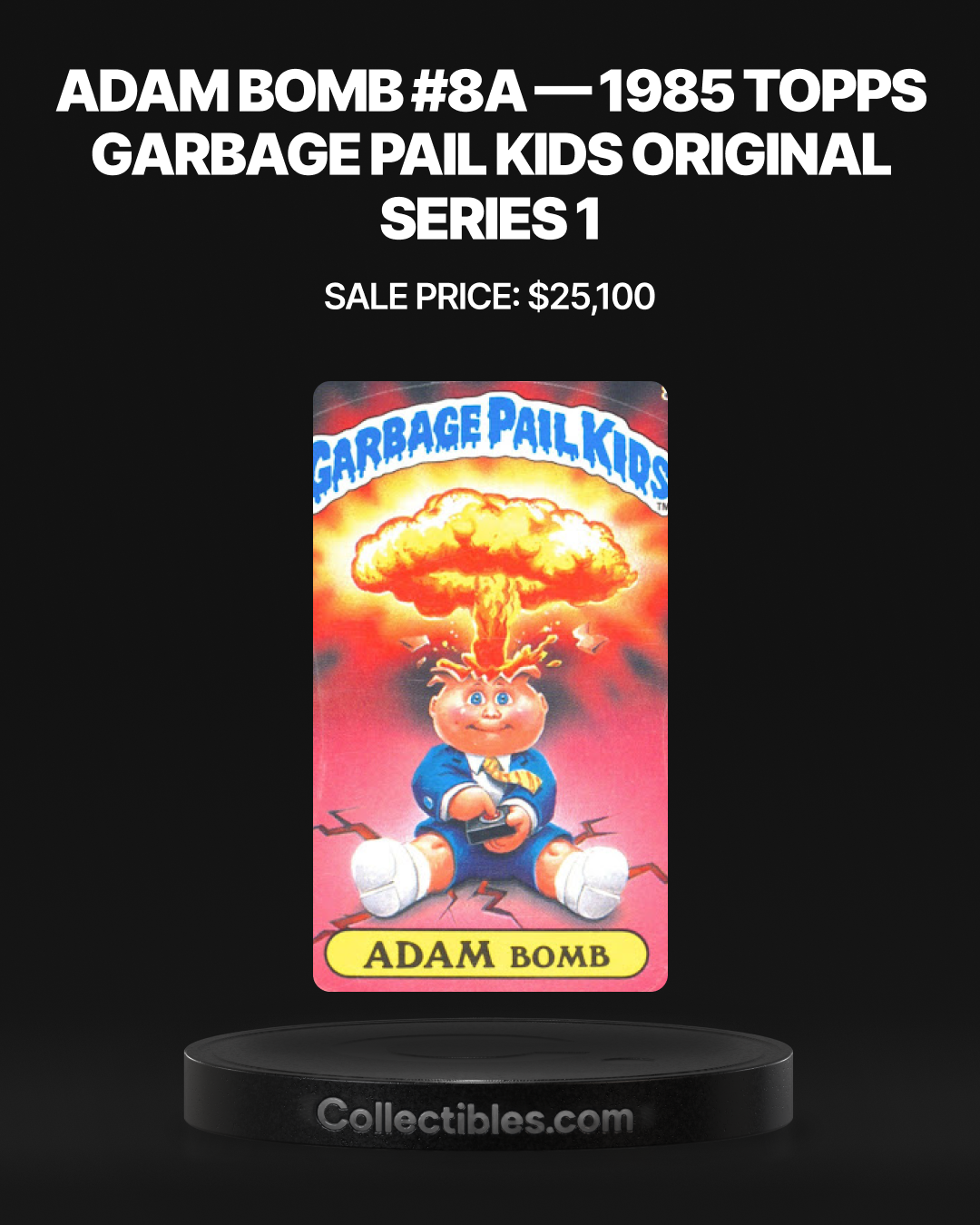
3. Adam Bomb #8a — 1985 Topps Garbage Pail Kids Original Series 1 (PSA 10) — $25,100
Sold for: $25,100
Where: eBay
When: 2022
The most expensive Garbage Pail Kids sticker ever sold publicly. Adam Bomb depicts a kid pressing a detonator as a mushroom cloud erupts from his head — a perfect snapshot of 1980s Cold War cultural anxiety played for grotesque comedy. The character became the de facto mascot of the entire GPK franchise, appearing on the original packaging for Series 1 through Series 5.
That packaging exposure is the value driver — the same dynamic that elevated Charizard to the top of the Pokémon card market. Adam Bomb wasn't just one of 82 stickers in Series 1; he was the face of the line. The PSA 10 checklist-glossy variant that crossed $25,100 represents the apex of GPK survivors.
What Collectors Should Know: GPK stickers from Series 1-5 in PSA 10 condition consistently outperform later series, and within Series 1, checklist-back variants regularly command premiums of 50-100% over standard backs.
Most Expensive Garbage Pail Kids Sticker - Image courtesy of PSA
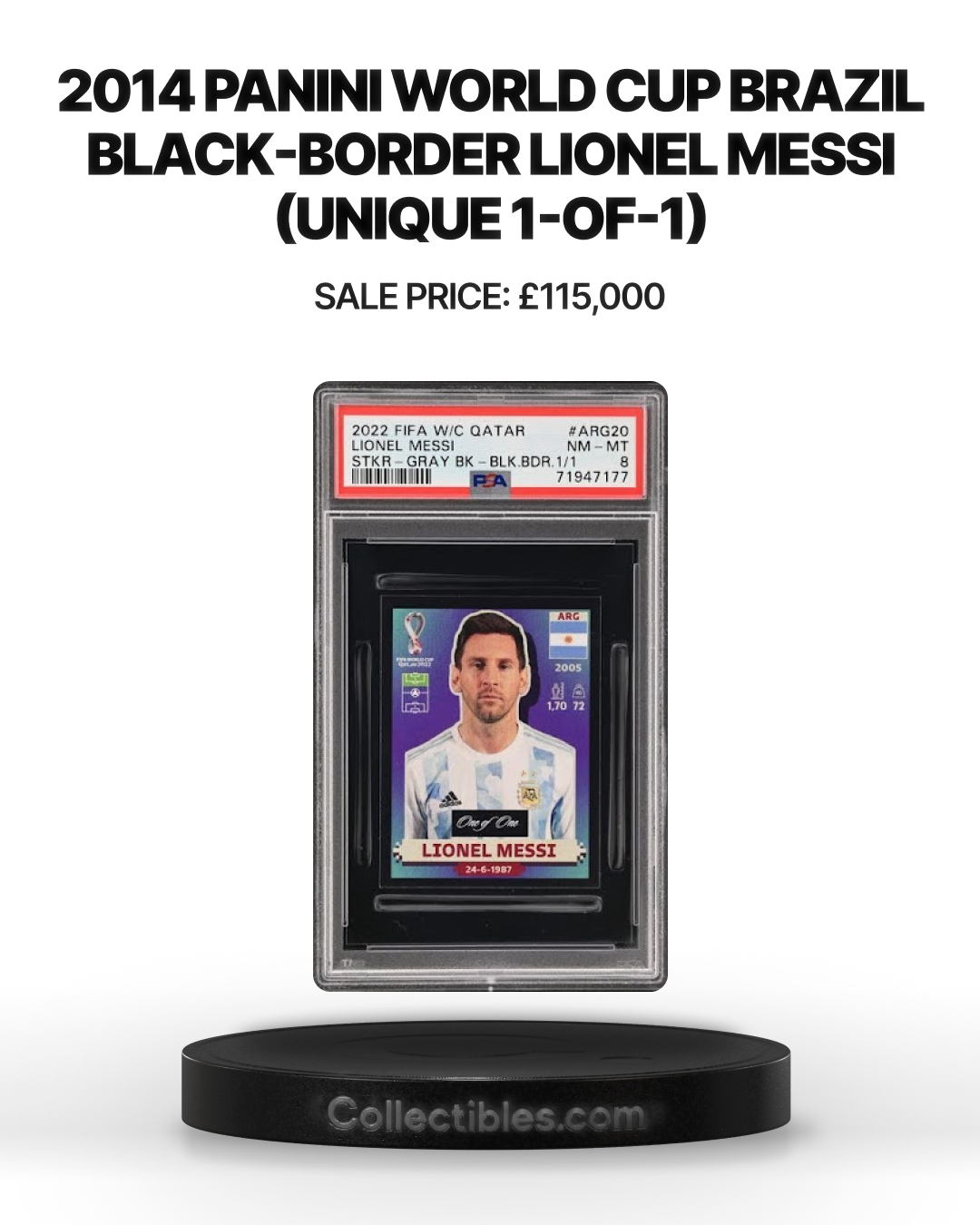
2. 2014 Panini World Cup Brazil Black-Border Lionel Messi (Unique 1-of-1) — £115,000
Sold for: £115,000 (~$140,000)
Where: Goldin Auctions, New Jersey
When: Reported sale circa 2023
The 2014 FIFA World Cup Panini sticker album marked Panini's first attempt to engineer one-of-a-kind variants into a mass-market sticker release. The company produced four colored-border variations of each player sticker — gold, silver, bronze, and black — with the black-border versions issued in microscopic quantities as ultra-rare chase pulls. The Lionel Messi black-border is the holy grail of the entire 2014 release.
The seller, Henry Barrios of Virginia, had purchased roughly 300 packets of 2014 World Cup stickers, attempting to complete his collection. Among them was the unique black-border Messi — pulled blind, recognized for what it was, and consigned to Goldin Auctions. The sale established Panini's modern parallel-border framework as a legitimate high-end chase mechanic, and it stands as the most expensive Panini World Cup sticker ever sold.
What Collectors Should Know: Gold-border, silver-border, and bronze-border variants from the same 2014 release also command four- and five-figure premiums depending on the player and grade.
Most Expensive Lionel Messi Sticker - Image courtesy of PSA
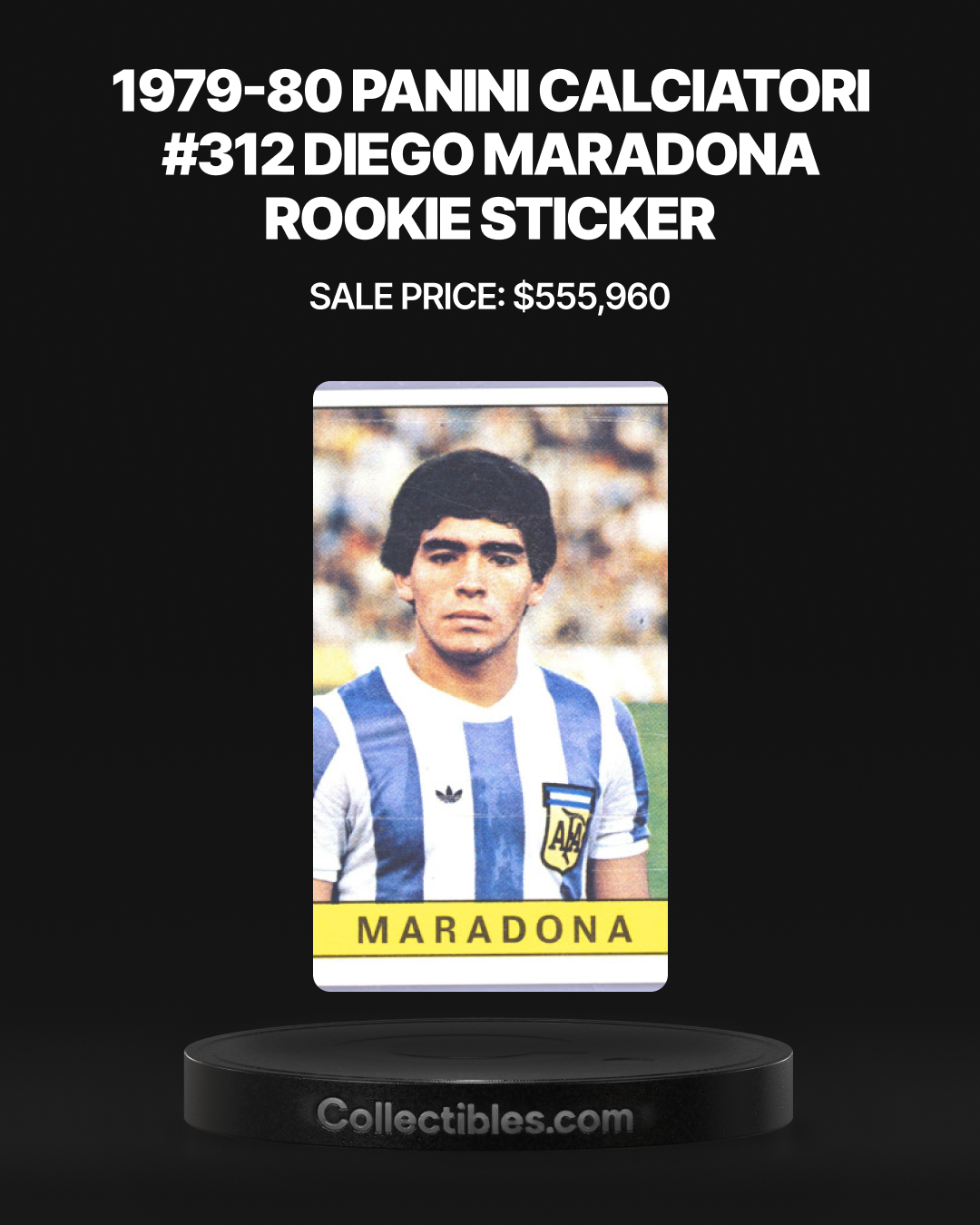
1. 1979-80 Panini Calciatori #312 Diego Maradona Rookie Sticker (PSA 10) — $555,960
Sold for: $555,960
Where: Goldin Auctions
When: April 2021
The most expensive sticker ever sold at public auction — A PSA Gem Mint 10 example of the 1979-80 Panini Calciatori sticker featuring a 19-year-old Diego Maradona during his Argentinos Juniors years — the first season Panini included him in their flagship Italian league sticker set. The sale shattered the existing soccer record (a $288,000 Pelé Alifabolaget sticker sold months earlier) by nearly double and established the Maradona Calciatori as the undisputed sticker grail.
The math behind the price is brutal. Of more than 620 Panini Calciatori #312 Maradona stickers graded by PSA, only 19 have ever achieved Gem Mint 10. The sticker was issued during a period when Panini's Italian production used flimsy adhesive backing and razor-thin paper stock — survival in mint condition required the original child collector to receive the sticker, choose not to peel it, store it carefully, and have a family that didn't throw it out for four decades. The Goldin sale also benefited from the broader 2021 sports collectibles boom, but the underlying scarcity hasn't changed: PSA 10 examples remain effectively non-existent on the open market.
What Collectors Should Know: BVG 9.5 examples of the same Maradona sticker have sold in the $40,000-$50,000 range, illustrating how dramatically PSA 10 status compounds value at the top of the sticker market.
Most Expensive Sticker Ever Sold - Image courtesy of PSA
The future of sticker collecting
Three forces are reshaping the category, and a fourth is forming on the horizon.
The 2026 World Cup is the immediate catalyst: Hosted across the United States, Canada, and Mexico, the tournament will produce Panini's biggest-ever sticker release, with new rookie stickers for Lamine Yamal, Endrick, and a generation of players who will define soccer collecting for the next decade. Historical pattern: every World Cup pulls the vintage sticker market upward as new collectors enter the hobby through the current album and graduate into chasing vintage rookies. The 2026 release should accelerate Messi, Maradona, and Pelé sticker prices regardless of what happens on the pitch.
Digital stickers are now a parallel market with real money in it: Counter-Strike 2 (formerly CS: GO) tournament stickers issued during the EMS Katowice 2014 event have become the most expensive digital "stickers" on Earth — the Titan (Holo) Katowice 2014 sticker currently trades around $130,000, with private CS2 sticker inventories valued in the millions. These aren't physical objects, but they're functionally identical to physical stickers in collector behavior: applied or unapplied, rare or common, condition-graded, traded through specialized marketplaces. The line between physical and digital sticker collecting is now functionally erased at the top of the market.
Premium parallels and 1-of-1 variants are the new chase mechanic: Panini's 2014 World Cup black-border experiment proved that mass-market sticker releases can support genuine one-of-one rarities, and the company has scaled the model in every release since. Modern sticker collectors aren't just trying to complete the base album — they're chasing gold, silver, bronze, and black parallel variants whose print runs are deliberately microscopic. The market is increasingly bifurcated: the base album for the kids, the parallels for the investors.
The fourth force is the one collectors are watching for: No one knows yet who the next Maradona-class rookie sticker will belong to. Lamine Yamal is the leading candidate from the European game; Endrick from Brazil; a generation of NWSL players in the US is emerging as the American card market discovers women's soccer. The pattern is consistent: every two decades, a single 19-year-old's debut-season sticker becomes the next grail. The 2026 World Cup is the first major checkpoint to find out who.
Why Collectibles.com is built for sticker collectors
Sticker collecting started with two brothers buying a stack of unsold paper in Modena and ended up as a global market where individual examples trade for more than half a million dollars. The hobby's defining feature is the same one that makes it brutal: stickers were meant to be used. Most were. The survivors that weren't — pristine, ungraded, sitting in a shoebox somewhere — are the entire reason the top of the market exists.
If you have old stickers, albums, or unopened packets from any era, the first move isn't selling. It's cataloging. Capture every sticker, every album, every original packet in an organized inventory, then let market data tell you what's worth grading, what's worth holding, and what's worth letting go. Collectibles.com is purpose-built for that work — scan, value, track, and showcase your collection in one place, alongside a community of collectors who understand exactly what they're looking at.
Add Your Stickers to Collectibles.com —>
Fun Sticker Facts:
What is the most expensive sticker ever sold?
A 1979-80 Panini Calciatori #312 Diego Maradona rookie sticker graded PSA Gem Mint 10, which sold for $555,960 at Goldin Auctions in April 2021. It remains the record for any sticker sold at public auction.
What makes a vintage sticker valuable?
Three factors: condition (PSA 10 examples can be worth 50-100x lower-grade copies), rarity (1-of-1 variants, regional releases, and small-batch productions like Brazilian Glasslite figures or Italian Calciatori issues), and provenance (documented ownership history, original album-pull authentication, and third-party grading from PSA, SGC, or BGS).
Are unpeeled stickers worth more than peeled stickers?
Always. Peelable stickers were designed to be applied to album pages, and the act of peeling permanently damages the sticker's resale value. Unpeeled, ungraded copies in good condition can be worth 10-50x peeled examples, and grading service slabs preserve that unpeeled condition permanently.
Where are the most expensive stickers sold?
Goldin Auctions, Heritage Auctions, PWCC Marketplace, Fanatics Collect, and Catawiki are the major venues for high-end sticker sales. Private sales through specialty dealers also account for a substantial share of record transactions, particularly for one-of-one variants and signed albums.
Do CS2 digital stickers count as collectibles?
Increasingly, yes. Rare Counter-Strike 2 stickers from the 2014 Katowice tournament trade in the tens to hundreds of thousands of dollars, with the entire CS2 sticker market now functioning as a parallel digital category alongside traditional Panini and Topps sticker collecting.
Whether you're just starting the hobby or already on your way to building a serious collection, Collectibles.com offers a super app to easily organize, manage, value, and showcase everything you own — all at your fingertips.
Download our IOS App
Download our Android App

Disclaimer: All content on Collectibles.com and shared publicly is for educational and informational purposes only and does not constitute investment, financial, tax, or legal advice. Collectibles.com and its partners are not registered investment advisors. Investing in collectibles carries a high risk of loss, including total loss of principal, and is speculative and unsuitable for many investors. Past performance is no guarantee of future results. Always consult qualified professionals before making decisions. No recommendations or solicitations are intended.

