

A sports card that nobody looked at twice five years ago now sells for six, seven, even eight figures — and everyone online has a theory about why. Is it the player, the grade, the story, or something most collectors never see? To answer where sports card value actually comes from, we sat down for an episode of Collectibles.com Unscripted with Jason Simonds, Consignment Director of Sports at Heritage Auctions — the largest collectibles auction house in the world, and one of the few people who is literally in the room when these record prices get set.
The number one question we hear from collectors is the same one Jason hears every day: "What's my item worth?" It's rarely a simple answer — but it almost always comes back to three things working together: condition, rarity, and provenance. Understand how those interact, and the headline prices stop looking random. The first step is knowing exactly what's in your collection. — Collectibles.com
What follows is the clearest breakdown we've heard of the forces that turn a piece of cardboard into a trophy asset. Spoiler: the player on the front matters far less than most people assume.
Start With Demand: Why the Whole Market Lifted
Before you can explain any single sale, you have to explain the room. According to Simonds, the escalation isn't mostly about macroeconomics — it's about people.
"Why are these prices escalating so quickly?" he said. "Frankly, it's just because there are more people in this hobby than ever. This is a growing industry, a growing collectible community." Sports cards, Pokémon, and sports memorabilia are now treated as legitimate markets, drawing what he calls "a more sophisticated audience participating in this who have deep pockets."
That shift brought a new kind of buyer. "You're seeing a lot of new money entering this who want to own these trophy assets," Simonds explained. "'I want to own the single best basketball card. I want to own the single best Pokémon card.'" It's the same logic that governs fine art, where the single best example of something routinely trades in the seven, eight, or nine figures. In sports, that ceiling is still climbing — and the buyers chasing the top are what pull the entire market up behind them.
That demand is the engine. But demand alone doesn't explain why one copy of a card sells for millions while an identical-looking copy sells for a fraction of it. For that, you need the Collector's Lens — the three forces that decide where value concentrates.
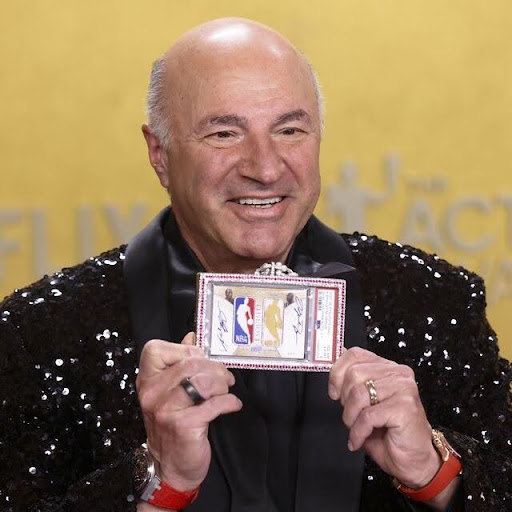
Fig.1: Kevin O’Leary with his Duel Gold Logoman - image courtesy of Yahoo
Force One: Condition — Why Grading Is the Biggest Lever of All
If there is a single most important driver of modern card value, it's condition — specifically, condition as measured by third-party grading. And the mechanism that makes it so powerful is conditional rarity.
"They may have printed hundreds of thousands of 1952 Topps Mickey Mantle cards," Simonds said. "But there are only three PSA 10s. That's a conditional rarity." He's right: PSA has graded exactly three 1952 Mantles as a perfect 10, and just six as a 9. The print run can be enormous, and the card can still be functionally unique in top grade. At the upper echelon, buyers often aren't focused on the subject at all — they're focused on the grade.
The clearest proof is the card that broke the internet. A PSA 10 Pikachu Illustrator sold for $16.5 million — the most expensive trading card ever — while a PSA 9 of the very same card has changed hands for a fraction of that, in the low millions. A single grade point, in other words, accounts for well over ten million dollars in value.
Why such a cliff between grades that a casual observer couldn't tell apart? Because grading operates on a scale of tiny margins:
- PSA 8 (NM-MT): near mint to mint — a strong, collectible card.
- PSA 9 (MINT): a clear step up, often several times the value of an 8.
- PSA 10 (GEM MINT): the top of the scale, where conditional rarity and record prices live.
"If football is a game of inches," Simonds said, "card grading is a game of millimeters." The difference between a 9 and a 10 can be a hair of centering, a single errant print dot, or the faintest touch on a corner.
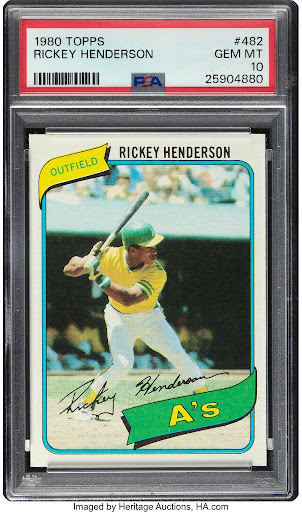
His favorite example is the 1980 Topps Rickey Henderson rookie — a card "everyone has," printed in the millions and plagued by centering issues, print dots, and subpar paper stock. That perfect storm makes the top grade brutally hard to earn: more than 34,000 have been graded by PSA, yet only about two dozen have ever reached PSA 10. The price curve tells the story. A PSA 7 runs about $150 to $200; a PSA 8 around $400; a PSA 9 roughly $2,000; and a PSA 10 peaked near $180,000 in 2021 — close to a 100x jump for a single grade point.
The takeaway for collectors is blunt: at the high end, you aren't buying the player so much as the grade.
Fig.2: The record-setting 1980 Topps Rickey Henderson rookie card - image courtesy of Heritage Auctions
Force Two: Rarity — Scarcity, Pop Counts, and the Grail
The second force is true scarcity — how many copies exist at all, and whether that number can ever grow.
Nothing illustrates it like the T206 Honus Wagner, the card Simonds calls "the quintessential sports card to own. It's the grail." Heritage recently sold one — authentic but altered — for $5.856 million against an estimate of roughly $3 million. Almost nobody on the street could name Wagner, and the card itself, in his words, is "pretty beat up." It didn't matter. "You either have one, or you don't," he said. "It's a club."
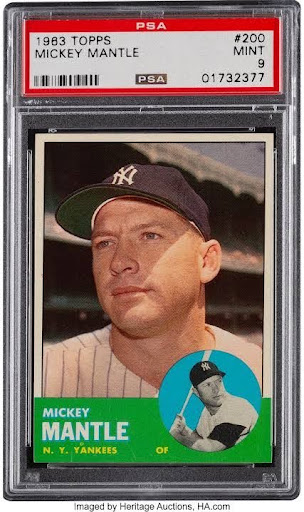
Scarcity is also why vintage keeps climbing while supply sits frozen. Simonds pointed to a 1963 Topps Mickey Mantle in PSA 9: "How many more are going to be graded PSA 9 in the next five, ten years? Probably not many, if any." He checked a ten-year-old auction listing and found the population essentially unchanged. "If the supply of that card stays stagnant — which it probably will — as more people enter this space and chase top-tier vintage, you're going to see it rise. It has to."
This is the purest expression of the market. "We're dealing with one of the purest forms of market," he said. "We're dealing with cardboard, and supply and demand are the only driving factors here."
Fig.3: 1963 Topps Mickey Mantle in PSA 9 - image courtesy of Heritage Auctions
Force Three: Provenance — Authentication, Grading, and Trust
The third force is provenance: the authentication and documentation that let a stranger trust what you're selling. In cards, grading does double duty — it measures condition and certifies authenticity, which is exactly why the grading companies have become so central.
"The pre-grading era was the Wild West," Simonds said. "You never knew what you were getting. You'd order from a catalog, it would say near mint, and it would arrive vastly overgraded." Independent grading replaced that chaos with a standardized, trusted yardstick. As our host put it, the grading companies may not be the kingmakers — "but they certainly are the value makers."
Provenance also governs the gray areas. Heritage has handled multiple restored Wagners, including a notorious die-cut example where someone "literally created a new card around" the original. Simonds's position is that restoration is acceptable at this level as long as it's disclosed — and then "you let the bidders decide." Full transparency is what protects the market. The same principle drives the premium on game-worn memorabilia that can be photo-matched to a specific game, and on cards with a documented chain of ownership.
Condition, rarity, provenance — get all three aligned, and you have a trophy. Miss one, and the price reflects it.
How the Number Gets Set: Estimates and Comps
Knowing where value comes from is different from knowing what a specific card will bring. That's the job of an auction estimate — and Simonds says the biggest misconception is what an estimate even is.
"It's not me telling you what it's worth," he said. "It's us telling you, based on where the market is, this is a good guide for what to expect." Heritage builds estimates from comparable sales and prior results, and publishes them — which doubles as a safeguard. "I'm not publishing a hundred-thousand-dollar estimate on a twenty-thousand-dollar card," he said. It forces an honest conversation with the seller before anything hits the block.
The system is calibrated but never exact. A blue-chip card like a PSA 8 1986 Fleer Michael Jordan "transacts four or five times a month" and is easy to price. A one-of-a-kind piece is a different animal: an Autographics red-ink Michael Jordan short print that had essentially never surfaced was estimated at $40,000–$50,000 and, by Simonds's account, sold for over $200,000. Across a whole sale, though, it balances out — Simonds says Heritage's auctions typically realize around 105% to 125% of aggregate estimate, with the last one landing near 112%.
Is It Collecting or Investing? Both — and Mostly Collecting
With prices this loud, it's fair to ask whether the hobby has become pure speculation. Simonds's answer is reassuring for purists.
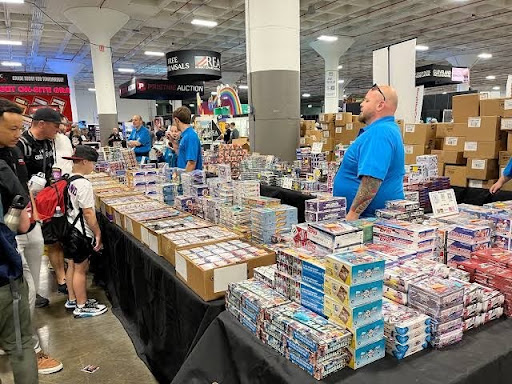
"The bedrock of this hobby is collecting," he said. "For every million-dollar sale, there are a million one-dollar sales." Walk into a local show — not the National, just a VFW hall on a Saturday — and you'll find families and kids buying their teams. Baseball cards spike every spring training; basketball spikes at tip-off. "That's not investing. That's people reminding themselves it's baseball season."
At the very top, he estimates it's closer to a 50/50 split between collectors and investors — the person paying six figures for an Ohtani card is often buying an asset. But that tier is a sliver. "The other 95% of the volume," he said, "is squarely occupied by collectors." And the two aren't mutually exclusive: Simonds himself is chasing a 1984 Star basketball set, one card short, purely for love — while also buying cards he simply believes are underpriced.
Fig.4: Local card show - image courtesy of Sports Digest
If you want to find a local card show near you, click here.
Will It Last? The Case for a Younger, Healthier Hobby
Simonds has been predicting a correction "for a couple of years now, and it still hasn't come." His honest read: some corners are overheated, others are a new normal.
The overheated pockets are the low-population modern cards that spiked too fast. He walked through the 1986 Fleer Jordan PSA 10 — roughly a $20,000–$25,000 card for a decade before it spiked to a record $738,000 during the COVID boom in early 2021, then slid through the $500Ks, $400Ks, and $300Ks, bottoming near $150K before settling back around $350K. When a card is pop ~300, and most owners are in for $20,000, a run to three-quarters of a million turns a lot of fans into sellers. "Those pop-30, pop-40, pop-50 cards that spike suddenly — you'll see a correction," he said. "But that's a five-month, ten-month correction, not a five-year one."
Long term, he's firmly bullish — and the reason is demographics. The average age at a card show in 2002, he estimates, was around 58. Today it's closer to 28. "When you have a young audience entering a market like this, that is so healthy," he said. These are collectors who could be in the hobby for life.
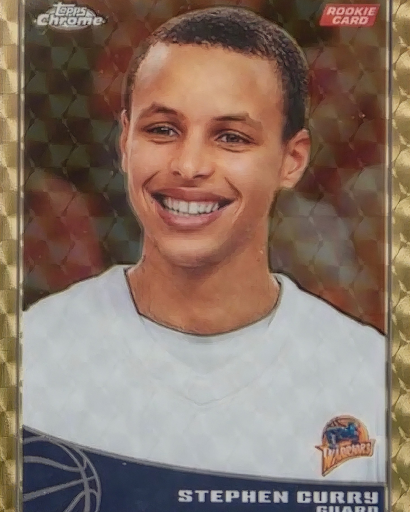
Feeding that energy is the modern "chase card." Simonds credits Fanatics' Michael Rubin with the goal to "10x the hobby," and the delicate balance it requires: flood the market and nothing holds value; starve it, and you price out the ten-year-old buying his first pack. The answer has been chase cards — like the 1-of-1 Shohei Ohtani "Dual Gold Logoman" autograph, pulled from a pack by a Florida collector and sold for $11 million in 2026, the Cooper Flagg rookies, or the still-missing 2009 Topps Chrome Curry Superfractor — that create genuine treasure-hunt energy. "There's always going to be a collector base nostalgic for that hunt," he said. "Someone was the winner who pulled that card."
Fig.5: The still-missing 2009 Topps Chrome Curry Superfractor - image courtesy of Topps
What It Means for You (and One Piece of Seller Advice)
For everyday collectors, the practical lesson is the one Collectibles.com repeats constantly: if you want to lock in value, get it graded. Grading is what converts a raw card of unknown condition into a certified, authenticated, tradeable asset — condition and provenance, stamped in one step.
And if you ever hit a genuinely big card, Simonds's advice is the opposite of what adrenaline tells you to do:
- Slow down. "Don't let anyone pressure you that there's a deadline. Take your time, enjoy that you hit this."
- Don't over-shop it. Quietly showing a card to hundreds of buyers before the auction poisons the room — "the last thing you want is an entire audience of people who already turned it down."
- Get honest guidance. Talk to a resource who isn't trying to buy it from you, look at real comps, and only then decide whether to hold, list, or consign.
Final Thoughts
Where does a sports card's value come from? Demand lit the fire — more collectors, new money, and a market that now treats the best cards like fine art. But which specific card becomes a trophy comes down to the same three forces serious collectors have always weighed: condition, rarity, and provenance. The player on the front gets the headline; the grade, the population, and the paper trail writes the price.
The most useful thing any collector can do is simply know what they're holding. As Simonds reminded us, for many people a card is the most valuable thing they own after their house — and there are still treasures hiding in shoeboxes and storage rooms, from signed index cards to unopened vintage wax.
Collectibles.com is built to help you find out. Scan, identify, value, and track your entire collection in one place — and keep the passion strong, alongside a community that lives for the hunt.
CLICK TO WATCH THE PODCAST
Download our iOS App
Download our Android App

Frequently Asked Questions
What makes a sports card valuable?
Three forces working together: condition (its grade, which is where "conditional rarity" lives), rarity (how few exist and whether more can be made), and provenance (authentication and documented history). Demand sets the overall market level, but these three decide why one copy sells for millions, and an identical-looking one sells for far less.
Why does one grade point change the price so much?
Because of conditional rarity. A card may exist in huge numbers overall, but only a handful are in the top grade. A PSA 10 Pikachu Illustrator sold for $16.5 million — the most expensive trading card ever — while a PSA 9 of the same card has sold for a fraction of that, a gap of well over $10 million for one grade point. As Heritage's Jason Simonds puts it, "card grading is a game of millimeters."
Is the sports card market collecting or investing?
Both, but mostly collecting. Simonds estimates the very top of the market is roughly 50/50 collectors and investors, while about 95% of all volume is driven by collectors finishing sets and buying their teams.
Does getting a card graded actually add value?
Yes. Grading certifies a card's condition and authenticity in one step, turning a raw card of uncertain quality into a standardized, trusted, tradeable asset — which is why graded cards command a premium and anchor nearly every record sale.
Is a market correction coming?
Possibly for specific overheated modern cards — low-population pieces that spiked quickly can give back value over months. But Simonds is bullish long term, citing a collector base whose average age at shows has dropped from roughly 58 in 2002 to about 28 today.
Disclaimer: All content on Collectibles.com and shared publicly is for educational and informational purposes only and does not constitute investment, financial, tax, or legal advice. Collectibles.com and its partners are not registered investment advisors. Investing in collectibles carries a high risk of loss, including total loss of principal, and is speculative and unsuitable for many investors. Past performance is no guarantee of future results. Always consult qualified professionals before making decisions. No recommendations or solicitations are intended.
Written by Dillan Prince

